Youth Infusion in Systems

This article by Adam F.C. Fletcher explores what Youth Infusion can look like in systems, including education, government, healthcare and more.

Youth Infusion is the idea that as humans in our society, young people must be viewed and treated as full and integral members of every system they are part of, and this graphic shows what is included…

A system is a set of things that work together to accomplish a goal. Young people today can be parts of many systems, including their homes, families, schools, neighborhoods, youth programs, and more. Youth Infusion is the idea that as humans in our society, young people must be viewed and treated as full and integral members of every system they are part of.

Education, government, families, the economy, and healthcare are all examples of systems.

Understanding Systems

Made by humans in order to deliver various functions, every society in every nation worldwide is made of systems. The economy, law enforcement, healthcare, religion, and public health are all systems.

Systems are made of many interconnected parts. There are eight elements in any system:

  1. Cause: Every system exists for a reason.
  2. Parts: Every system operates with different parts.
  3. Functions: There are ways that every system functions with.
  4. Roles: Whether passive or active, everybody has a job in the system.
  5. Flaws: Every system has problems, challenges and breaks.
  6. Redundancy: Systems can have unnecessary or backup parts.
  7. Organization: Every system has at least one beginning, middle and end.
  8. Additions: There are parts attached to systems.

An Example System

Think about schools. Schools are systems. This is a breakdown of each element of a system as we look at schools.

  1. Cause: Schools exist to support democracy, including the economy and politics.
  2. Parts: There are grade levels and topics throughout the school system.
  3. Functions: More than learning and teaching, there are social, administrative, and many other functions in public schools.
  4. Roles: Schools have specific roles for each person involved, sometimes named and often unnamed.
  5. Flaws: Every school all the time; there are no perfect schools.
  6. Redundancy: Summer schools and in-school suspension are redundancies in education; sometimes entire schools, teachers, or districts can be redundant.
  7. Organization: The hierarchal structure of the education system within a school and beyond the building are the organization.
  8. Additions: Along with the academic and cultural purpose of schools, there are additions to the education system including public health, social conditioning and more.

Youth Infusion can ensure that young people are meaningfully involved throughout systems instead of being tokenized, over-simplified, or otherwise excluded.

Understanding Youth Infusion

Youth Infusion is based in the idea that every young person is a full human being right now, and not simply an adult-in-the-making. It assumes that people value young people and want justice, equity, and possibilities for every child and youth in our society. Youth Infusion is a way to think about who, what, where, when, why, and how all young people can have meaningful roles throughout the places that impact them.

Understood through its parts, Youth Infusion affects three pillars of our lives:

  • Individuals—Every person has their own feelings, thoughts, ideas, and beliefs that form their attitudes towards young people.
  • Communities—Geography, proximity, relationships or otherwise define our culture, and every young person is part of at least a few different communities.
  • Organizations—These are formal entities or structures that serve young people include their families, schools, nonprofits, and other organizations.

These three pillars are the basis of Youth Infusion. There are many other aspects to understanding this approach, including Youth in Day-to-Day Operations, Intergenerational Reciprocity, Infusing the ‘Y’ in DEI, and more.

Youth Infusion in YOUR System

There are many layers in systems, and Youth Infusion can happen in every one from the personal level to the community level, and from the community level to the national and international levels – and all points in between!

Are you ready for Youth Infusion in YOUR system? Whether you work in a nonprofit organization, government agency, K-12 school, or run a counseling firm or consulting company, YOU can benefit from Youth Infusion. For more information about moving forward, contact us today!

Adults Pay Close Attention to Their Youth Allies

This citywide network functions more like “a family” which deserves special attention. Why? Because community activists as well as parent organizations are not always successful in building a coalition that also includes the primary stakeholders–students themselves.

482Forward is a collective of neighborhood organizations, parents, and students who attend Detroit charter and public schools. 482 is the prefix for zip codes in Wayne County, populated by many ethnicities, languages, religions, etc.

This citywide network functions more like “a family” which deserves special attention. Why? Because community activists as well as parent organizations are not always successful in building a coalition that also includes the primary stakeholders–students themselves.

The structure provides some clues about this effective intergenerational engine for education justice. Each member organization has a youth organizing hub and an adult ally. These student reps form the 482Forward Youth Collective which has the advantage of students working more autonomously on issues they deem most important and also, students can determine their own pace which can pose a conflict if adults are moving too slowly or perhaps too fast.

Ongoing Adult Openness

The Youth Organizing Director describes this enlightened adult mindset.

Adults are open to learning and changing with youth, for example, there’s an instant desire to get it right with they/them pronouns. They are constantly asking what do youth want to do…Is this in line with what youth are doing?

This attentiveness to 482Forward student leaders was evident following the murder of George Floyd. While some adults wanted to take to the streets, the youth wanted to protest the school-to-prison pipeline that overwhelmingly impacts black and brown students inside their own schools. What began to emerge was the idea of a campaign to defund the Detroit Public Schools’s own Police Department which includes security officers, private security, cameras, alarms, metal detectors, etc. and to reallocate this $33 million policing budget for mental health, including to trauma-trained staff.


Intergenerational Research in Action

In keeping with 482Forward deliberative process for developing a long-term strategy, a research team was composed mainly of students from the 482Forward Youth Organizing Collective along with two adult allies.

  • Survey – Youth developed questions to gauge both students’ and parents’ views. (COVID and the prospective reopening of schools, mental health support during virtual learning, safety in schools, interactions with school police officers, and what an improved school experience would look like).
  • Focus Groups – 800 participated in youth-led listening sessions or completed the survey over two months.
  • Data Analysis – Together the youth and adult team conducted a thematic analysis of the qualitative data and disaggregated it from the quantitative data to see detect overlaps in responses from the survey and listening sessions.

The data generated specific Invest/Divest demands including using the school police budget for more counselors, social workers, nurses, de-escalation training, restorative justice, conflict resolution training, etc. At this juncture, students, supported by parents and community supporters, organized protests at the Board of Education and Superintendent’s Office.

One concrete win is the Detroit Board of Education agreed to create a Police Oversight Committee to investigate public complaints about its Police Department and officers. This interim decision strengthens the resolve of the Invest/Divest organizers and this intergenerational teamwork.

The commitment from our elders to the engagement and support of the youth has never once wavered, which is what makes the foundation of this network so unique. Our slogan “Nothing About Us Without Us” reflects that sentiment perfectly. The youth are the key players in this game, and we can’t take any steps forward without their consent, leadership and partnership. 

– Dillon Cathro, 482Forward Director of Youth Organizing

Another success factor to note is this very diverse coalition makes certain its budget has the funds to compensate the student leaders for their time.

Can you recommend other organizations like 482Forward that we can profile and highlight the secrets and structures that produce genuine youth-adult collaboration? 

Youth in Day-to-Day Operations

These public health professionals respected and relied on the wisdom of teens. They knew firsthand the unique influence and power of youth not only with their peers but parents, policymakers, politicians, and the press.

“I don’t interact with youth much at all.”

This is a common refrain we hear from seasoned professionals and veteran advocates, especially those who concentrate on issues that directly impact children and adolescents.

Imagine an organization where the primary stakeholders join the adults in day-to-day operations. It has happened!

Youth Impact on Organizational Culture

In the case of one high impact nonprofit, more than half the paid staff were under 18. The staff ratio: usually hovering around 10 adults to 25 teen employees, most from historically marginalized communities.  Youth staff were not relegated to limited roles but infused in all aspects of this nonprofit:

  • researching issue areas;
  • helping conceptualize and write grant proposals;
  • developing advocacy strategies for local or statewide initiatives;
  • creating social media campaigns;
  • leading process to recruit, interview and hire new youth; and
  • participating in interviews for prospective adult staff.

In the main office of Youth Empowered Solutions! (YES!) in Raleigh, North Carolina, I saw worn bean bag chairs, unframed posters, and other evidence where young staff ‘lived’ several days a week after school.

During my roundtable discussion, the lively atmosphere and banter contrasted with the thousands of meetings I’ve experienced. I felt like the adult staff at YES! were imbued with dare I say… JOY.

My experience and intuition would lead me to conclude this job satisfaction and spirit are linked to their close collaboration with their young colleagues. This mindset is described by Warren Bennis and Robert Thomas:

 “We discovered that every one of our geezers who continues to play a leadership role has one quality of overriding importance: neoteny. Neoteny is the retention of all those wonderful qualities that we associate with youth: curiosity, playfulness, eagerness, fearlessness, warmth, energy…Neoteny is a metaphor for the quality-the gift-that keeps the fortunate of whatever age focused on all the marvelous undiscovered things to come.”

Geeks & Geezers: How Era, Values and Defining Moments Shape Leaders (2002)

The co-founders of this nonprofit had extensive experience collaborating closely with teens, notably fighting Big Tobacco in North Carolina–the top state producer of this lethal product.

These public health professionals respected and relied on the wisdom of teens. They knew firsthand the unique influence and power of youth not only with their peers but parents, policymakers, politicians, and the press. 

Organization Outcomes

Over the past decade, Youth Empowered Solutions! has employed more than 100 young people from all across North Carolina, and empowered thousands of youth from 25 states. This intergenerational advocacy engine is credited with changing hundreds of policies and systems to address racial inequities and adolescent health disparities ranging from food deserts to dental care. As co-founder Katie Spears Warner describes:

The role of young people contributed to a more cohesive team, reduced burnout and attrition among adult staff. There was this sense of family and belonging and we were dedicated to the work and to one another. When you are supporting the growth and development of young people, while also committing to the humanity of people and racial equity-the experience is nurturing and healing in many ways.

I would make the assumption that is why many of the YES! founding adult staff stay for a decade and the youth staff stay connected well beyond high school years, through college or the workforce and into their adult livesoftentimes still connecting today to their former Adult Leads.
 

Now YES! has evolved into YES! for Equity and officially is operating as part of the Atlanta-based Partnership for Southern Equity. Learn more about this exciting organizational development from my long-term colleague Katie Warner (KWarner@psequity.org). 

Our workshop teaches the essential skills for adults to adapt to this new power dynamic which includes making it the norm to interact with the rising generation. For more details, please contact us!

Innovative Intergenerational Research Model

Our collaboration as teachers, parents, and students resulted in findings that were meaningful and actionable–an impressive feat for non-professional researchers. I am excited to see additional community-based, co-design processes develop in the future and continue to prove their value.

Students usually are included with parents and teachers in the proverbial three-legged stool.

In reality these stakeholders, who represent 92 percent of the K-12 population, are excluded from deliberations on most every consequential education issue. One innovative intergenerational research model puts students on equal footing.  

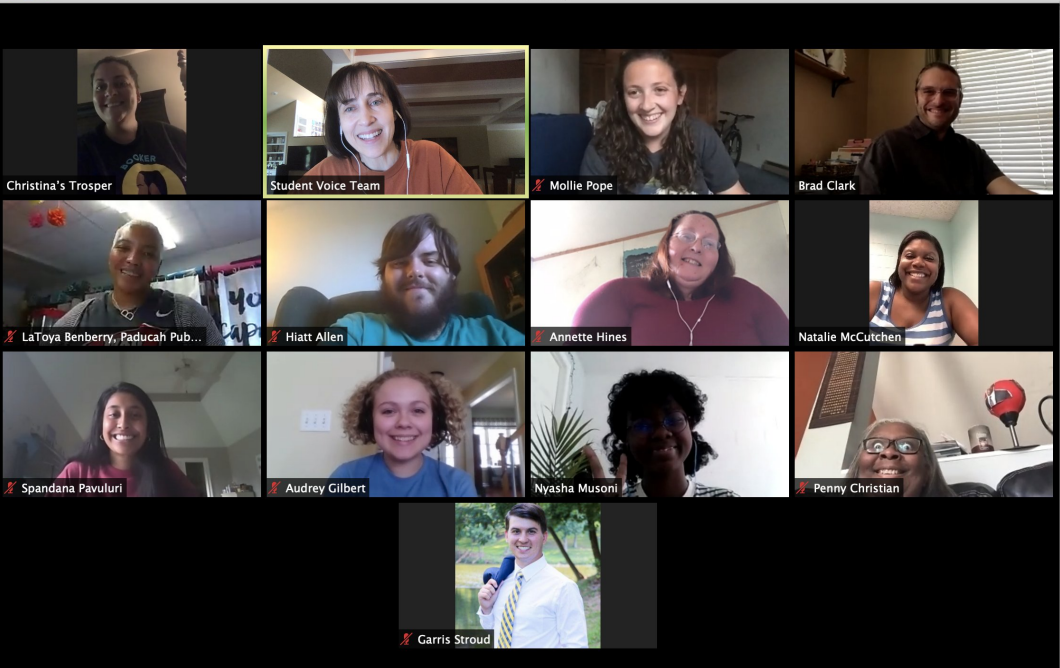
“Intergen 9” is the revealing name chosen by the researchers who produced the revealing Coping with COVID Teacher and Family Study.

The age range of this racially diverse research team consisted of three parents, three teachers, and three students representing eight school districts across Kentucky. Additional support came from the Prichard Committee for Academic Excellence, including another trio of facilitators. 

Over 2,000 completed the survey and interviews were conducted with parents, grandparents, and teachers of children with special needs. The data led the “Intergen 9” to advocate for several policies such as “Create more internet hot spots, especially in rural areas that are under served.”

In the words of Garris Stroud, one of the “Intergen 9” teachers:  

Our collaboration as teachers, parents, and students resulted in findings that were meaningful and actionable–an impressive feat for non-professional researchers. I am excited to see additional community-based, co-design processes develop in the future and continue to prove their value. 

Another key point emphasized by Audrey Gilbert, one of the high school student researchers:

I think that what’s so excellent about this intergenerational model is that you had three groups of stakeholders that could’ve all disagreed on everything and advocated for only their side of the issue. Instead, we all came together to say these issues are an issue for all of us. If all these groups of stakeholders work together, we have a bigger impact than working separately.

School systems across the country will find relevance in the revelations and recommendations summarized in Coping with COVID. It is important to recognize that the research team, including the students, received compensation for their time and Seek Common Ground helps to establish this norm. Moreover, this participatory action research illustrates that the three-legged stool cannot stand up without these primary stakeholders.

It is time for young people who are contributing their time and expertise to be paid. This policy should be non-negotiable both by grantors and grantees. We are keen to hear your reaction about this intergenerational model and also the controversial issue of compensation. 

We also want to highlight equally significant research by the Prichard Committee Student Voice Team that was co-designed by students and adult research advisors. Coping with COVID Student-to-Student Study reflects data based on nearly 9,500 students from across the state.

Please share your comments below and/or contact us so we can continue the discussion together! 

Intergenerational Reciprocity

How often does the CEO and Co-Founder boast that his position stated on his employment contract is Executive Assistant to Generation Z?

How often does the CEO boast that his position stated on his employment contract is Executive Assistant to Generation Z? Josh Thompson of Civics Unplugged is unequivocal about his subordinate role in this youth-serving organization. 

Here are some revealing highlights from Baratunde’s How To Citizen podcast with Executive Assistant Thompson and 17-year-old Civics Unplugged Steering Committee member Zoë Jenkins. This interview shows how adults with impressive credentials in education, law, business, etc. truly toss the reins to their younger colleagues. This unusual power shift results in dynamic intergenerational reciprocity.

  • ENGAGE IN RADICAL COLLEGIALITY: “There’s lots of wisdom. [Josh and other] Administrative Assistants give a lot of feedback, advice and help. All the Co-Founders are mentors but we also are just friends. Young people get to have that relationship where you rely on them and they rely on you. It’s been a really transformational experience.” – Zoë
  • REVERSE ROLES: “Other civic engagement work is kid-light advisory. We are kid-heavy. They cannot flip the switch and make that culture change organizationally overnight.” – Josh 
  • BELIEVE THERE’S NO MINIMUM AGE FOR IDEATION: “We don’t want to be treated like we are 30 because we’re not 30 but to be given the same value for our opinions and what we know. Obviously we don’t have the same wisdom as someone who has lived much longer but our ideas do not have less merit. It just means we may need more support from intergenerational partners to operationalize those ideas.” – Zoë
  • DEBATE BRAVELY: “[My] role at Civics Unplugged is to pick fights with the kids that I consistently lose. It’s one of the funnest things but that dialogue is super important. The launch of Civics 2030 was my first fight and made me roll my eyes. I’ve been in politics, government and public service and how many superintendents put out a 3-year strategy or 5-year turnaround plan. Here we go recreating a generation that ends up with a whitepaper on the shelf and get dusty…Nope, this is an actionable 10-year plan.”  – Josh
  • OVERCOME ‘MINOR’ OBSTACLES: “The real beauty of Josh and the rest of others Co-Founders is they have a lot of value but a huge value is they are over the age of 18 and they can sign contracts for us.” – Zoë
  • FIND THE MONEY: “Other nonprofits and political campaigns wanted access to our kids [Fellows]. They want them to be interns to run product, social media campaign, think about how to engage youth but that’s a leadership position not an internship. But [they say] we don’t have the budget and so we [Civics Unplugged] will chip in…We are investing capital directly into these projects.” – Josh 

Let us know how this multi-racial intergenerational organization inspires you. Contact us for details about our workshops and consulting on how to begin the pursuing systemic change at your organization.

P.S. Nominate high school students or encourage them to apply to the Civics Unplugged 2021 Fellowship @ https://www.civicsunplugged.org/apply

You Might Like…

Does Your Youth Program Transact or Transform?

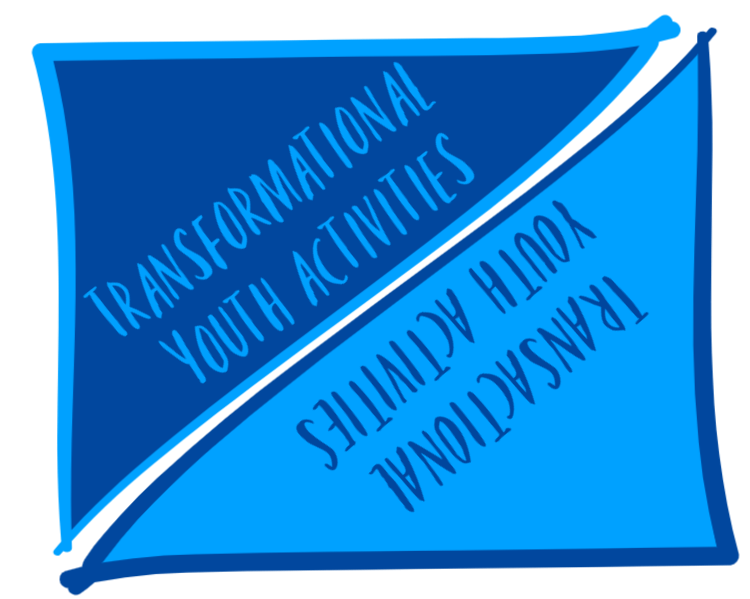
Transformational or transactional youth activities
Are your youth activities transformational or transactional?

When was the last time you thought about WHY young people come to your youth program or classroom?

  • Do they come to get jobs, earn money, and in order to become gainfully employed?
  • Are there rewards for attendance or contests for participating?
  • Are youth punished in some way for not attending?

These are traits of a transactional youth activity.

  • Do youth see their capacity to create, build, change, and make the life they want to live as the most important reason for coming?
  • Are adults seeking to learn with youth or take action together for change?
  • Can young people choose whether or not they want to be there and adapt for changing times?

This is a transformational program.

Transactional Youth Activities

A lot of youth programs in general are built on transactional relationships based in giving and receiving, i.e. “I give you this and you get that.” Forming the premise for much of our economy, this type of relationship is evident in…

  • Many schools where students earn grades by performing certain tasks;
  • Stores where youth pay money for food, clothes, music and more;
  • Friendships that are reliant on trading attention when needed.

A lot of youth involvement, youth voice, and youth engagement activities are transactional relationships where young people become involved because they can get a reward for being there. This might be a grade, kuddos from adults, or a bullet point on their resume.

Transactional youth activities have several elements. They…

  • Focus on extrinsic motivation
  • Appear practical
  • Resist change
  • Discourage independent youth actions, thinking and reactions
  • Reward performance
  • Constrain thinking
  • Rely on passive youth voice
  • Deliver directive youth activities
  • Emphasize formal structure
  • Focus youth on their own self-interest and reassure adults’ self-interest

They are also common, and easily compared to other youth-serving activities. Sometimes these relationships are necessary, especially at the outset of a youth activity. However, the challenge is that many adults believe this is the only way to involve young people.

Transformational Youth Activities

Alternatively, Youth Infusion insists that youth and adults join in together because each age group changes because of the interaction. These transformational relationships allow everyone the room they need in order to be whole, become engaged, and make a difference in their own lives as well as the lives of the people around them.

Transformational youth programs have many elements. They…

  • Check adultism
  • Are clearly co-led with youth and adults
  • Encourage healthy risk-taking
  • Engage youth in difficult decision-making
  • Share organizational consciousness between youth and adults
  • Inspire and foster new thinking
  • Adapt, pivot and respond
  • Are proactive
  • Are visionary

Transformational youth activities are unfortunately rare throughout the youth service sector, and throughout education. Throughout their processes, they are revelatory, teaching youth and adults new things while expanding the impact each has on the other and on themselves. By their nature, transformational youth activities are creative, necessitating unique, divergent, and eclectic thinking, actions, and outcomes. Because of this, they are also particularly lifting to those who are involved.

Is your program transactional or transformational? Are you ready for transformation? It’s exciting, rewarding and enlivening to be engaged in transformational work, but can be frustrating to change from one style to the next. It can also be necessary to focus on basic human needs and interact in a transactional way with youth, at least for a period of time.

If you’re ready to explore whether your youth activity, youth program, youth organization or K-12 school can move from transactional to transformational approaches, we want to help. Contact us to learn more about Youth Infusion right now »

Youth on Governing Boards

The pinnacle of power often centers on a nonprofit’s Board of Directors. The data show that only 21.4 percent of these key governing roles are held by people of color–not much change from the BoardSource’s survey way back in 1994. A commitment to representation that reflects our increasingly younger and more diverse population is one of the transformative shifts needed to replace White Supremacy.

Anecdotal evidence reveals that young people who serve on boards contribute in significant ways such as strategic planning and also change the culture. The CEO of one environmental education nonprofit claims the high school students, who are treated as equals on the Board, often surpass the adults in their serious attention to the Board of Directors handbook, their careful analysis of budgets along with penetrating questions. Another executive director credits young people not only making Board meetings more fun but causing older members to follow through. If you’re interested, you can learn more about youth as board members from the Freechild Institute »

One student position on a local school board remains an anomaly. Even then, these high school reps have only an advisory role. It took 38 years to get legislation through the Maryland Statehouse to allow the Student Member of the Montgomery County Board of Education to be able to vote on the hiring of the Superintendent, capital and operating budgets, collective bargaining, school closings, COVID re-openings, and boundaries. Montgomery County is the 16th largest school district in the country. It seems totally out of whack that the primary stakeholders–those in the classroom–are outnumbered. Imagine if AARP had eight trustees under 25 and only one over age 50.

“Students are the most valuable and least consulted education policy experts in America.”

Amanda Ripley, The Smartest Kids in the World

But most adults would not agree with Ripley as explained in typically colorful language by my colleague, Adam to Education Week last year: 

“Some adults talk to me about the inmates running the asylum. It’s this fear, this concern that kids don’t know what’s best for themselves, and as adults we have the best experience and knowledge.”

Adam Fletcher, June 11, 2019

Minors and young adults serving as reps or directors signal an institutional shift that has the potential to accelerate the snail’s pace of achieving diversity on nonprofit boards. 

P.S. To build a truly multi-racial intergenerational organization, youth also need to be involved not on a monthly or quarterly basis but interacting regularly with staff, otherwise known as Youth Infusion.

Do you agree with Adam about “the inmates”? We are eager to hear your reactions – please share them in the comments section!

That Certain Something

One assumption behind youth infusion is the belief that deliberately, strategically, systemically, sustainably, and powerfully weaving youth throughout organizations will lead to less exclusive, more popular, and more common experiences of youth engagement for every youth in every community, all of the time.

One assumption behind youth infusion is the belief that deliberately, strategically, systemically, sustainably, and powerfully weaving youth throughout organizations will lead to less exclusive, more popular, and more common experiences of youth engagement for every youth in every community, all of the time. 

Unfortunately, that’s not the norm. Instead, a lot of programs are missing that certain something that makes youth infusion different.

Many youth engagement opportunities are based on establishing an ambiguous set of experiences for a certain number of young people to achieve particular outcomes according to the will of adults. Unfortunately, these approaches can result in inequitable, unsustainable and sometimes imperceivable changes in organizations. Worst still, they can feel unjust, unequal, and ill-considered by the very youth who sought to become involved.

Through youth infusion, we’re proposing that organizations can go further with intention. Some of these intentions include:

  • Transform Traits: The innate values, ideas, beliefs and opinions of the people involved including youth and adults
  • Sharpen Skills: The actionable, practical abilities that young people and adults need in order to work together to change the world
  • Capture Knowledge: The concepts, strategies, facts, and other thinking accumulated and created by the people involved in youth infusion
  • Accentuate Actions: These are the tangible steps young people and adults take to make a difference in their own lives, communities and beyond

Once organizations, programs, projects and communities state their intentions in these areas, they separate themselves from typical youth engagement, traditional youth involvement, and stagnate youth voice. Instead, they step forward and make a conscientious choice to transform the world through transformative action with young people.

What do you think? Share your thoughts in the comments below!

You Might Like…

Infuse ‘Y’ in DEI

It’s time to embed young people in these organizations to actually increase diversity, to actually practice inclusion and the most challenging, to actually share power to achieve equity.

The National Council of Nonprofits drives home the question: “Does your nonprofit create opportunities to listen to the voices directly from community, grassroots, or young leaders in low-income, under-served and/or marginalized populations within its community?” The answer often falls to a vice-president or team charged with Diversity, Equity, and Inclusion (DEI). Apart from token engagement, youth-serving institutions do not practice what they preach given the exclusion of this entire age group. 

It’s time to embed young people in these organizations to actually increase diversity, to actually practice inclusion and the most challenging, to actually share power to achieve equity. This is distinct from a youth advisory committee or an internship program. As we all know, it is an unfair burden and an impossible task to ask a few young people to represent their generation—the most diverse in history.

Expanding DEI

  • Diversity – representing many young people of color and multiple identities
  • Equity – redistributing power and engaging in real shared decision-making
  • Inclusion – respecting a broad range of perspectives by youth of many racial and socio-economic backgrounds

This process of infusing the ‘Y’ in DEI does not and should never happen overnight. Serious organizational commitment to create an intergenerational culture by senior staff and the board is a prerequisite. Just as those in charge of DEI trainings for the entire staff—especially to address systemic racism—workshops also need to pull back the curtain and interrupt individual and institutional biases about youth as well as confront adultist attitudes.

Youth don’t have the academic or professional credentials but by virtue of their station in life and firsthand knowledge about their peers, rarely are young people privy to the circle of strategizing and decision making. Equitable inclusion of diverse youth seems only just. In fact, ‘justice’ is being added to DEI which, as Richard Leong with Act to Change suggests, could translate into a more catchy acronym: JEDI.

What do you think about incorporating both the ‘J’ and ‘Y’ in DEI? Please reach out to us to learn more.

Graphic: League of Women Voters of Delaware

Self-Care for Youth & Adult Allies

Whether you are younger or older, here are some points you can learn to help with your self-care.

If you are engaging in youth infusion during the pandemic, you might be affected by online activities differently than other people in your family or organization, including other youth and adults, too!

Youth and adult allies need to take care of their mental health, social health, emotional health and physical health. Since people involved in youth infusion can feel more responsibility than many others, we need to be intentional about taking care of ourselves.

Whether you are younger or older, here are some points you can learn to help with your self-care.

1. Watch Your Thinking

Online activities can be isolating for everyone, and being apart from youth and adults can be hard. Adults—including youth workers, teachers, nonprofit leaders and others—should reinforce to young people that they need to maintain their friendships and other relationships. We should do that too! It is actually an important way to develop and build lifelong communication skills, and can also make stressful situations a little more bearable.

Youth and adults should learn together to…

  • Listen to your self-talk. You should give yourself credit for building youth infusion and not be too self-critical
  • Keep things in perspective, try not to gossip, get the facts, and assume the best intent when possible
  • Acknowledge to themselves and others when things are weird, whether during the pandemic or otherwise
  • Remember changing to online activities can be hard work for yourself, and remember that nobody should be expected to get everything right
  • Its essential to take breaks when needed

2. Keep In Touch

Youth infusion can be hard on emotional and mental health, especially when we’re working online! It is common for both youth and adults to feel more depressed or anxious during conference calls, video trainings, or other online activities, especially during the pandemic. Many people are still figuring out how to adjust to programs, learning and activities that requires so much self-motivation. This can make young people and adults feel guilty or stressed for not infusing youth enough into their organizations, movements or lives. 

Adults and youth should learn together that…

  • Communication and collaboration makes the distance feel less distant between partners, including young people and older people
  • It’s important for youth and adults to take time to do things with people other than youth infusion activities. They should know that living youth infusion all the time can make it hard to separate from non-infused life from the rest of life
  • Many young people and adults are dealing with similar hard things in online activities, and they aren’t alone

3. You’re Not Alone

It can be boring and feel repetitive to be on the computer for every interaction with youth and adults. Learning we’re not alone, even if we’re one our own at home during the day, is important for youth infusion.

Youth and adults should learn to…

  • Talk to other people—including other students and adults—about what they’re struggling with and how they are taking action
  • Find hobbies, ways to relax, and healthy places to process difficult feelings brought on by youth infusion, whether online or in-person
  • Be encouraged to focus on the positives as much as possible

4. Move Your Body

Sitting in front of a screen all day is hard on your eyes and your whole body. Feeling responsible for youth infusion can add to those difficulties. Remember that, even though young people and adults are exercising our minds throughout the day, our bodies needs care too. In addition to helping with learning, moving can help with mental and emotional challenges too. Things like stress and depression can affect the body in physical ways too.

Youth and adults should learn to…

  • Stretch, take walks and breaks, and get outside if they can
  • Pay attention to posture and go easy on their backs
  • Keep a routine with things like food, sleep, etc.
  • Exercise to release toxic thoughts and stress, whether its simple or complicated activity


These are just a few thoughts about what young people and adults should learn about self-care. What would YOU add?