The Hidden Cost of Ignorance: Understanding Youth Perspectives

It probably sounds crazy but think about the benefits of “not knowing what you don’t know.” Understanding the full scope of an issue takes years and over time, that expertise can fence off the most basic questions and unconventional ideas. 

If those who possess such “wisdom” genuinely absorb the perspectives of aspiring young changemakers, this intergenerational collaboration can oxygenate the novices and experts. 

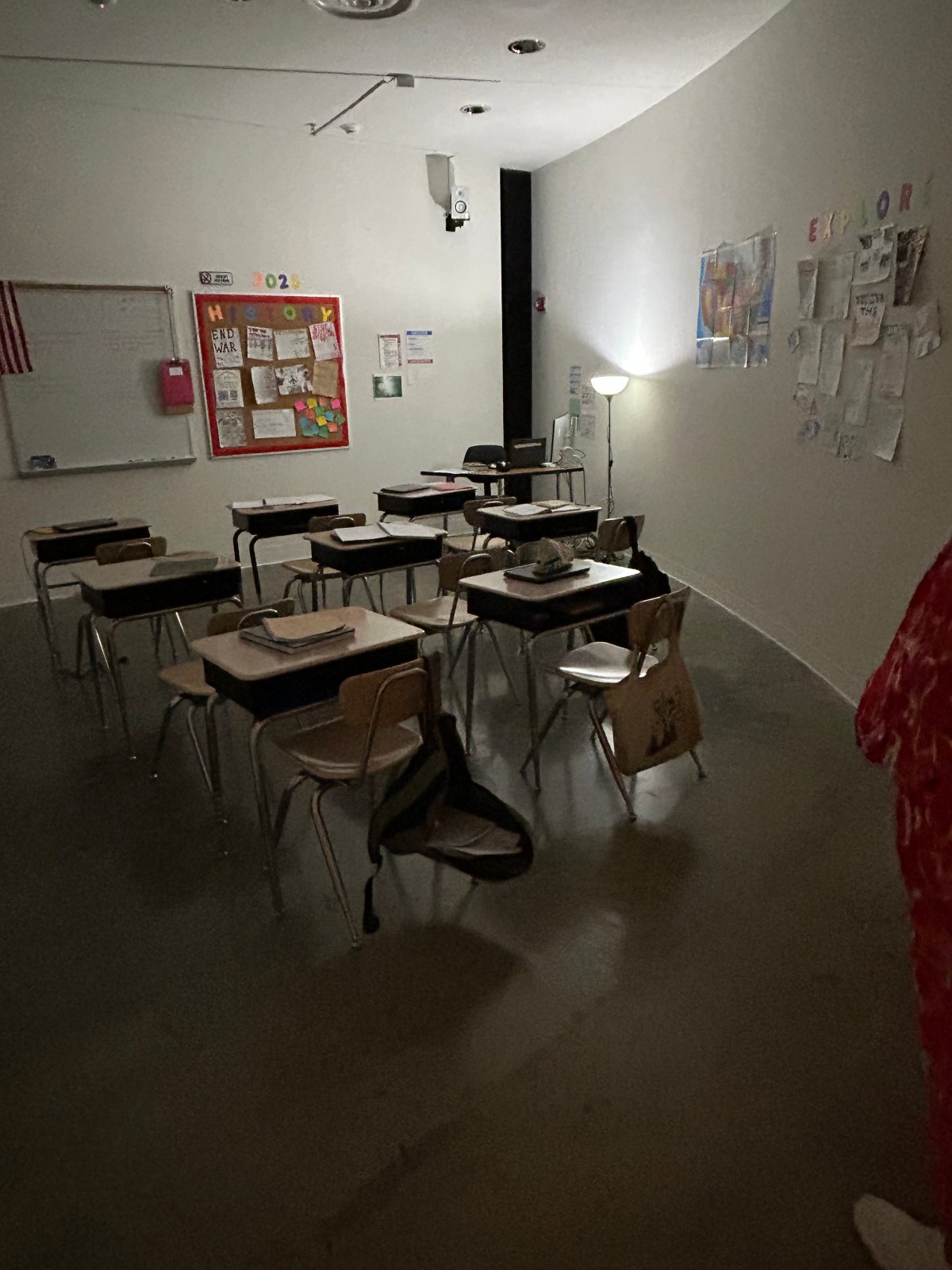
See how you react to “The Classroom, 2025,” exhibited by the Museum of Contemporary American Teenagers. Do you feel your synapses responding differently as you read the abstract of this art installation created by Alex Weiss, Mia Melton and Lois Proeller? (The photo above does not include the sound with the school announcing a drill.)

“My first lockdown was in elementary school. I was 8. We all hit in a corner, confused, scared, and not yet understanding that this would become all too normal. From the time my peers and I entered elementary school, we participated in various safety drills: Fire drills, weather drills, and shooting drills. We learned how to make a classroom look empty and how to find the best places in the room to hide. We grew up in a culture where school shootings were a regular risk of going to school. 

It isn’t fair that our learning environment should come with a danger of death every single day. We beg for help and are ignored and when something horrific happens, all we get are “thoughts and prayers.” We don’t get change. We don’t get safety. We get politicians with their heads in the clouds. We get adults too obsessed with their Second Amendment rights to realize that their stubbornness is killing kids.

I hope that with this installation, adults can at least understand a fraction of what students have to go through. This is our reality, 12 years of our childhood. A constant and looming threat of mortality shrouds our foundational years.  In a lockdown, the walls close in and the classroom has never felt more like a jail cell. You look around at your classmates, not knowing if these are the people you’ll spend your last moments with.”

Especially issues that directly impact children and young people, it is almost unimaginable to make policies about them without them – especially because they don’t have a graduate degree! 

Please share your comments because the more perspectives the better!

– Wendy S. Lesko

What Teens Teach Us + Transform Adult Thinking 

If you’re reading this, thank you for rejecting screenagers, meanagers and countless other negative stereotypes that cause most adults to summarily exclude this age group in their organizatios. Whether young people are advocating for public schools, taking on billion dollar corporations, or reshaping the way adults see the world, their points of view carry a unique influence. Here are a few illuminating podcasts that remind us of how everyone gains a wider lens when adults chart a new path of youth inclusion and commitment to intergenerational growth. 

Get Schooled

On Election Day 2024, the Kentucky Student Voice Team played a crucial role in defeating a ballot amendment that sought to divert funding from public schools to private institutions. Imagine if only lobbyists and legislators had been active in this high stakes campaign . Two students interviewed highlighted how rural schools would be severely impacted, a perspective that carries significant weight—perhaps even more than that of the teachers’ union president or the legislator featured in this KSVT mini-series.

Baltimore Teens Persist!

This unforgettable episode of Code Switch delves into the fight against the $30 billion rail company CSX. Teens describe their reliance on their younger peers to bring “new ideas” and fresh tactics to this ongoing campaign, such as leaving bags of coal on policymakers’ doorsteps. These young citizen scientists combine hard evidence about coal dust with the lived experiences of elders, many battling cancer to make their case to state policy makers. . The co-host marvels at the “mutual respect” that emerges and admits she was initially concerned about exposing these youths to “grown-up cynicism.

Why Adults Lose the ‘Beginner’s Mind’

I love “children are the R&D wing of our species” in this Ezra Klein podcast. I have experienced many aha moments when hearing a new idea that emerges from a group of teens that oxygenates my mind. Professor Alison Gopnik describes “this kind of rebirth of plasticity and flexibility in adolescence…[to] consider new kinds of social possibilities, and to take the information that they got from the people around them and say, ‘OK, given that that’s true, what’s something new that we could do? What’s something different from what we’ve done before?'”

How to Better Understand Teens

This episode on 1A flips the script by starting with insights from 15- and 16-year-olds, followed by Ellen Galinsky, author of “The Breakthrough Years.” She credits 40 teens across the U.S. as

“co-creators” who took my research in a completely different direction than if I had just looked at the literature or just talked to adults.

Galinsky quotes a 12-year-old’s advice to adults: “Listen with – when I was a child’s mind – as well as now  – I’m an adult’s mind. In other words, understand our perspective, not just your perspective.” So much can be gained by this commitment to intergenerational interdependence.

Now It’s Your Turn. Please Share Your Favorites!

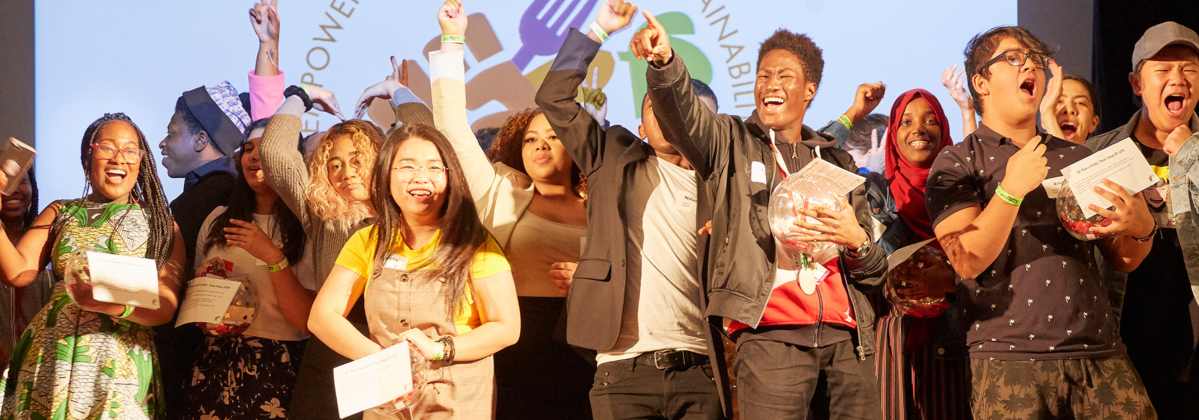
Photo Credit: Partnership for Southern Equity CEO, adult and youth staff

How to Avoid Mistakes with Staff Who Work with Young People

Imagine this scenario: You’re preparing to deliver a presentation to the senior executive team or Board of Directors. You’re likely running through a practice session, making last-minute tweaks to your slides, and bracing for tough questions.

Now, picture a different audience—25 teenagers you are meeting to invite into a policy advocacy campaign. Beyond the logistical headaches, your attention shifts to designing the opening minutes to set everyone at ease and introducing the issue in a captivating way. Then comes the carefully planned yet flexible choreography of interactive activities, culminating in actionable next steps. Ideally, you would  co-facilitate with a young person, dedicating ample preparation time to create a participatory atmosphere with the right balance of content and hands-on action.

Unlike a pitch to your colleagues, where even lukewarm reactions are manageable, presenting to teenagers can feel like performing as a comedian whose jokes fall flat.

As Crystal Oceja with Bridges USA and Stand for Children Tennessee explains:

“The adults approach you with no authoritative energy. They are very open. They are cool. They check in. They don’t force you to do anything.”

Skills Learned + Earned

Most professionals—especially policy experts—rarely interact with young people in their workplace. This disconnect often prevents them from fully appreciating the skills required to engage with youths. This gap in understanding extends to teachers, school counselors, social workers, YA librarians, and others. With over 70 million people under 18 in the U.S., only about 2.5 million individuals hold specialized degrees in youth work from higher education institutions.

The skills needed to work with young people are unique, distinct from those of parents or authority figures. Building trust and rapport at the initial make-or-break stage is crucial. It often requires embracing radical ideas and patiently discussing proposed programs, services, legislation—even those proven ineffective. One invaluable skill among these staff is what I call “a third ear.” This heightened listening skill goes beyond hearing, delving into curiosity and imagination, encouraging even the most timid young people to open up and share. It’s rare for such open dialogue to happen naturally, especially in intergenerational settings. One test is when young people laugh and joke alongside adults decades their senior, erasing hierarchical barriers.

Take Carolyn Cox, who runs  a Medicaid-supported program in Washington that trains and pays young people to become certified peer counselors. One Board member aptly describes her unique talent:

“Carolyn creates this aura because young people know she really lets them be themselves, lets them feel, and lets them speak.”

Working with teenagers—whose primary job is school and who often juggle family responsibilities—requires artful agility. Consider a 16-year-old managing health issues while preparing for an interview with a reporter. The pressure of deadlines and anxiety might make them want to quit. Supporting them through such challenges takes patience, empathy, and flexibility.

How Not to Undermine These Specialists

One of the most challenging aspects of this work is the lack of appreciation and respect from colleagues and/or executives. I recall a senior writer at a major magazine once commenting that I looked like a camp counselor because of my neon orange t-shirt, which featured a design created by a 17-year-old for our nonprofit’s national (victorious) grassroots campaign. This dismissive remark stung, reflecting the pervasive attitude that do not value those who collaborate in the new level of co-piloting with teens. 

Just as professionals must go the extra mile to gain the trust of young people, senior leaders should invest effort in understanding and recognizing the adults who work with them.

Plates are spinning in dozens of directions. For example, multiple campaigns involving hundreds of teens with the Kentucky Student Voice Team, which boasts impressive achievements in data analysis and policy advocacy. It’s co-founder and managing director Rachel Belin emphasizes that their co-designed work is “an art, not a science” and carries a “mental load” magnified by the actual and perceived legal liabilities of working with minors.

To recognize and respect these professionals, organizations can adopt intentional strategies, including

  • Allow flexible schedules to accommodate late afternoon and evening meetings, trainings, one-on-ones as well as weekend activities;
  • Assign a senior level staff person to act as a consistent liaison for those working directly with young people;
  • Seek technical assistance to help HR develop protocols for working with minors;
  • Include these employees who typically are low-level or junior staff in decision-making processes, validating their roles rather than sidelining them;
  • Consult these staff on how, not if, young people can be integrated into more organizational operations;
  • Ensure fair compensation for these youth specialists to reduce turnover and maintain the trust built with the youth cohort;
  • Encourage ongoing professional development through trainings, conferences, and networking opportunities that will help make youth representation the norm in nonprofits and government agencies. 

Share Your Experiences + More Info

Photo Credit:  UP for Learning

Do You Have These 10 Critical Character Traits?

Building a collegial partnership with teens is altogether different from the traditional power dynamics so common with a parent, educator, or authority figure.

When introducing the concept of infusing teens into various organizational operations, the flood of reactions from most adults is predictably negative. 

My nephew is obsessed with online gaming. 

My friend’s 16-year-old daughter is so lazy and clueless. 

These kids don’t want to have anything to do with us. 

This crime wave . . . I’m scared of them. 

Adults must take off their hat as a parent, aunt, educator or other authority figure to see each young person as an individual. To unlock the minds of the rising generation to imagine a better society, analyze problems, and develop strategies to pursue real change together, the responsibility rests with adults to demonstrate authentic respect and build genuine rapport. A collegial partnership is altogether different from the power dynamics so common with a mom or dad, teacher or principal, etc. 

  Encourage us. Build on our ideas. That gives us the confidence we need.  – Melissa K.

Essential Soft Skills for Sustained Collaboration

  1. Optimist – Hold onto hope as the antidote to cynicism
  2. Listener – Develop a “Third Ear” to be open to new thinking
  3. Learner – Keep your imagination faucet open
  4. Advocate – Share your own pragmatic idealism 
  5. Communicator – Text or talk 1:1 outside of meetings 
  6. Comedian – Joke and laugh
  7. Infomaniac – Explain relevant organizational efforts and future plans
  8. Choreographer – Connect teens with other staff and organizations
  9. Honest Broker – Establish feedback loops to respond to ideas
  10. Catalyst – Implement proposals as quickly as possible to show change happens

The passing of my very dear friend and wonderful colleague inspired this list of character traits. Pat Moore Harbour, PhD possessed them all. She served as the catalyst for my involvement with one of the Kettering Foundation’s Research Learning Exchanges that builds off her book, Community Educators: A Resource for Educating and Developing Our Youth

Contagious Curiosity

Given my dogmatic and persistent nature, I challenge the prevailing mindset of adults doing “to” and “for” youth. Pat and I had dozens of conversations where she showed such respect and curiosity about my approach that young people be recognized as wise community educators, influencing their peers as well as adults and the community at large. Instead of viewing youth as “under construction,” we often talked about our kinship with older colleagues who are committed to anti-ageist multi-racial collaboration. 

When discussing the concept of youth infusion – especially those under age 18 – in adult-run nonprofits and government agencies, Pat always was intrigued and honest. Her sense of possibility led her to emphasize the role of young people as “co-producers.” She embraced collaboration “with” youth – the key preposition and title of the recent book by David Mathews, founder of the Kettering Foundation (read more about WITH  here).

I was eager to discuss with Pat these two studies that conclude most adults lack her curiosity and interest in intergenerational interdependence. She would have shared her contagious optimistic outlook. 

Every conversation with Pat was a joy. Children laugh 300 times a day and the average for adults drops to only 15. She had me laughing and rethinking all the time.

Many of my closest friends and colleagues are not open to this concept of engaging with teens as genuine thought partners but I will not give up because of Pat’s spirit that will endure. How fortunate I am to carry Pat in my head and heart!

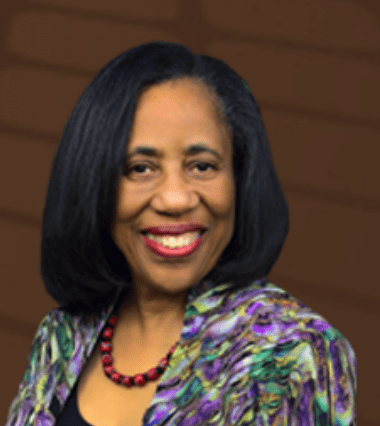
Photo credit: Dr. Pat Moore Harbour

Boost Your Org’s Talent Pool

Two film clips will challenge your thinking about the impact of intergenerational teamwork!

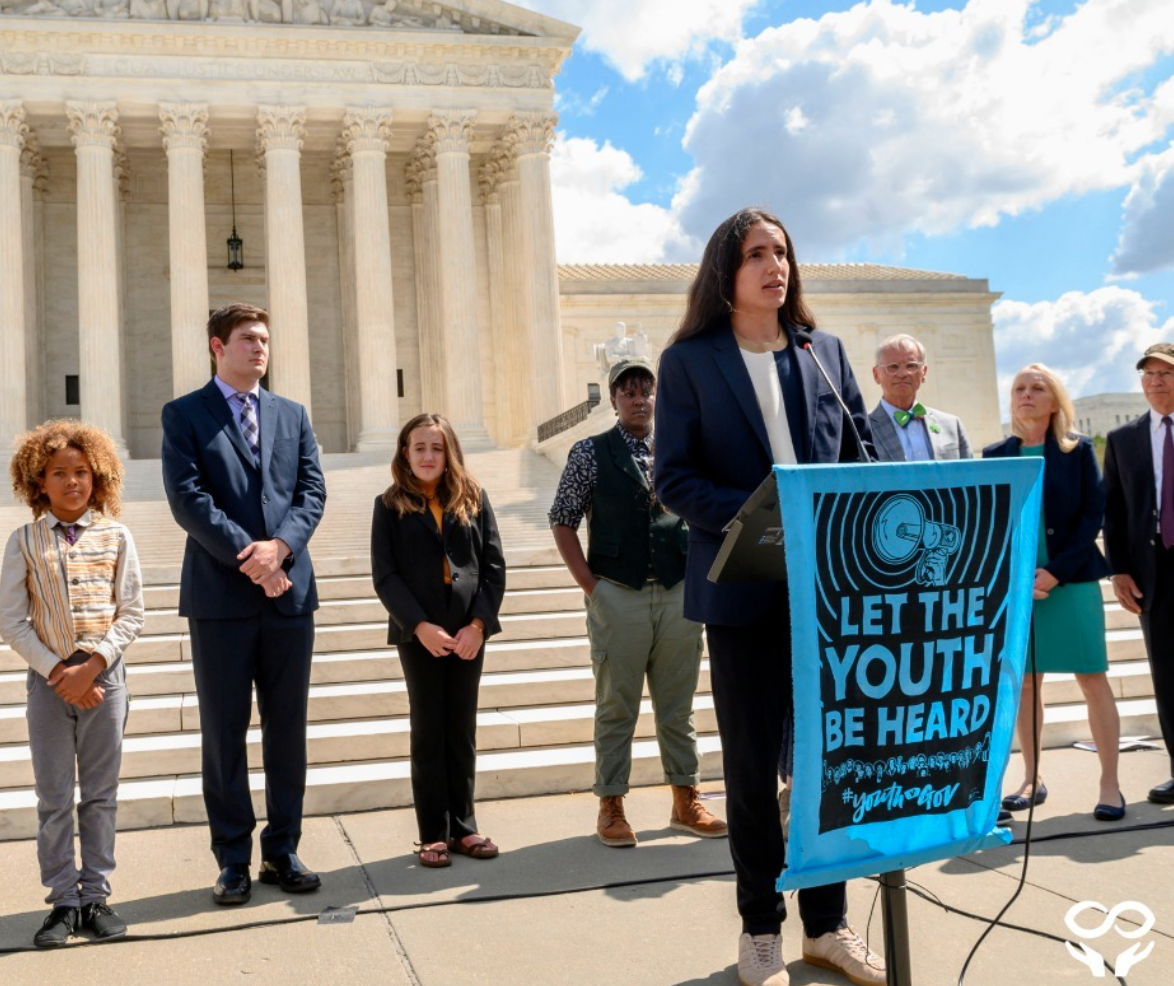
Xiuhtezcatl Martinez was in his mid-teens when his speech in Washington, DC to protest construction of the Keystone Pipeline XL captivated my attention. Now age 21, he has built his own leadership pipeline, as youth director of Earth Guardians and acclaimed hip hop artist. It is no surprise this multi-talented activist is one of the youth plaintiffs in a landmark climate lawsuit.

This pending case claims the federal government’s actions “violated the youngest generation’s constitutional rights to life, liberty and property, as well as failed to protect essential public trust resources.”

This is a trailer for Youth v Gov, a documentary on Netflix.

In the new documentary Youth v Gov on Netflix, you will meet 20 other plaintiffs who joined this case back in 2018. Each individual has gained a repertoire of talents, for example, the youngest plaintiff Levi, now 14, appeared on 60 Minutes

Many teens get involved trying ‘to right a wrong’ as very young children. Many start volunteering in their community or do a service-learning project which can lead to what I describe as the pistachio nut habit: once you get a taste for activism, you want to do more.

Idealism and impatience — traits that fade with age — lead young people to test dozens of ways to recruit diverse allies, promote their cause, build coalitions, present effective testimony to elected officials, etc. Real world hands-on learning is remarkable and fast.

Truly a Win-Win

Civic spark plugs like Xiuhtezcatl Martinez (pictured above at the podium outside the US Supreme Court) have mind-boggling skills. But each of the other plaintiffs contribute unique talents that accrue at a phenomenal clip. Each experience, including legal setbacks, fuels new learning and strategic thinking that benefit the cause.

The impact of intergenerational interdependence on older people deserves more attention. Youth v Gov reveals how younger minds oxygenate and augment adult-run organizations. Watch these two short clips from the documentary.  

  • Can you imagine this level of intergenerational camaraderie at a future retreat of your organization? (Cue to 10:30 – 13:26)
  • Can you visualize the senior leadership team being so energized by their collaboration with a solid cadre of young colleagues? (Cue to 1:27:39 – 1:28:18) 

No Attrition or Burnout

One common concern is that it’s not worth collaborating with young people because they will move on within a few months. Often the opposite is true. Genuine respect, authentic collaboration, and new dynamic opportunities increase the odds for long-term commitment.

It’s been seven years since filing Juliana v. United States by Our Children’s Trust. The staying power of these 21 plaintiffs persists. Adversity often strengthens resolve.

Recently the four plaintiffs from Florida initiated a statewide petition for renewable energy that resulted in a proposed regulation that was announced last month at a news conference with two of these activists. Many of these individuals are building their own leadership pipelines that will last a lifetime.

UPDATE West Virginia v. EPA decision:

Our Children’s Trust issued a news release on 6/30/22 that the US Supreme Court’s ruling to limit the Environmental Protection Agency regulatory authority over carbon dioxide pollution does not affect its federal or state youth-led climate lawsuits.

If anything, today’s ruling further demonstrates how important these children’s constitutional climate lawsuits are to address the deadly effects of our government-sanctioned fossil fuel-based energy system.

Photo Credit: Our Children’s Trust

Please share your thoughts and also let us know how your organization is infusing the youngest generations in its work. Call 301-785-1702 or contact us!

You Might Like…

Elsewhere Online

Attn Non-Profits: Five Recommendations for Anti-Racist Representation

Significant Youth Infusion is happening at this United Way in Seattle that is advancing beyond ‘youth voice.’

Back in 2002, I collaborated with United Way of America and co-authored Youth as Equal Partners which didn’t get much traction. Two decades later, there’s real reliance on young experts by the United Way of King County in Washington State. 

This prioritization of BIPOC youth can be traced to some tenacious Gen Z leaders who know firsthand that their grassroots organizations cannot compete or survive with the “Non-Profit Industrial Complex.” For over a year, the King County Youth Commission identified how voices of the historically excluded continue to be “devalued, dismissed and disregarded” and demand “a paradigm shift to dismantle this system that is so exploitative.”

We are tired of fighting for representation. It should be a given that the most impacted members of our community be given access to opportunities that are not only compensated but have actual decision-making power. 

Organization Seized the Opportunity to Collaborate with Youth

Typically young change makers guard their autonomy because they are distrustful and impatient with established institutions. In this case, these experienced young advocates are demanding systemic organizational transformation and fortunately, some equally committed staff at United Way share the same vision. An extensive 8-month research project by a team of young experts, who were paid about $25/hour by United Way’s Reconnecting Youth Initiative, generated Youth Tell All: Youth Centered Analysis on Youth Development in King County. 

Urgent, unequivocal, and uncompromising is how I would describe the eloquent young researchers who presented straightforward recommendations based on their in-depth interviews with nearly 40 Black, brown, Indigenous, and queer youth. 

Recommendation 1: Make young people integral to all decision-making, implementation, evaluation, and feedback processes.

Recommendation 2: It is vital to develop healthy and safe, as well as honest and consistent, relationships with young people.

Recommendation 3: Our decision-makers should represent our communities.

Recommendation 4: Build authentic relationships with our communities while centering the experiences of the people most affected.

Recommendation 5: Pay us for the ideas, time, labor, and leadership we contribute to your organization.

At this online presentation, the research team invited the executive director of the Seattle-based organization FEEST that lives by these five recommendations. High school students are involved at “a high level in strategic planning,” compensation is above $15/hour, and cardboard pizza has been replaced with nutritious Indigenous food in school cafeterias along with other significant wins.

Youth Tell All is not another report gathering dusk.  This spring, United Way of King County will begin a youth-led participatory grant process where youth will directly decide $100,000 funding to youth-identified priorities. 

When you work with young people, they provide feedback, and we realize they’re the product of the society we built. They have yet to be jaded and yet to be trained to mask what they’re feeling, so they are brutally honest. And when they’re brutally honest, they can call out where the discrepancies are in our work, so that we can listen to exactly where we need to and must make changes to better support youth.

Ruel Olanday, Jr. with United Way of King County

Influence is Inadequate

Read Youth Tell All  for a deeper understanding on how mainstream institutions, headed mostly by white adults, have the power to intentionally infuse young people into structures with real power to help produce lasting community change that benefits everyone.

These recommendations mean nothing if they are not acted on. The power of this report is that we did the research for you. From our Methods, all the way to our Glossary, which even includes related readings for you to deepen your understanding, the data is there. We interviewed the youth, we read the countless studies supporting our findings, and the youth led this project from the start to the finish.

The only thing that is left to do:

  • Pay the Youth who make it so your organization can thrive. This means Paying them with more than just experience, opportunities, or minimum wage. 
  • Give them decision-making power, not influence. This means making your decision-making processes so seamless that youth are already included from the start, and not when it’s time to “bring in the youth for feedback.”
  • Ensure that your organization, from staff, to board, represents the communities you serve.  Yes, this means hiring the same youth from your programs into these roles when they are ready! Yes, this means stepping down from a role that would best be served by a BIPOC community member. 
  • Mentor the Youth and develop safe, healthy, and honest relationships with them. This means giving them honest guidance, and not projecting your own trauma, or paternalistic feelings onto them and what you think they should be doing. 
  • Build authentic relationships with the communities you serve. This means all-year-round support, not just when your organization needs to check off a box for a grant deliverable.

Devan Rogers, Anti-Racist Community Organizer, and Abolitionist

Tracking Progress

More updates will follow here @ YouthInfusion.org on how United Way of King County is leading the way on authentic intergenerational interdependence to represent all constituencies in a county with over 2.25 million people.

Photo Credit: FEEST: Making Justice Irresistibly Delicious 

Resources

You Might Like…

Funders + Donors Judge Your Constituent Feedback

How your nonprofit engages with your beneficiaries can determine future financial support! There’s a new rating system by the world’s largest independent charity evaluator and leading donor matchmaker.

How your nonprofit engages with your beneficiaries can determine future financial support! There’s a new rating system by the world’s largest independent charity evaluator and leading donor matchmaker.

Charity Navigator has rolled out Constituent Feedback. This rating signals another concrete reason to engage in Youth Infusion. This is a process embedded in your organization–not merely a program.

Student Voice is not a slogan at Pace Center. Girls at campuses across Florida collaborated with their peers, school staff, juvenile justice and probation officers to identify why many were ending up in detention centers for not showing up in court. This intergenerational effort in Broward County produced numerous solutions that reduced arrests by 27 percent caused by failing to make it to court.

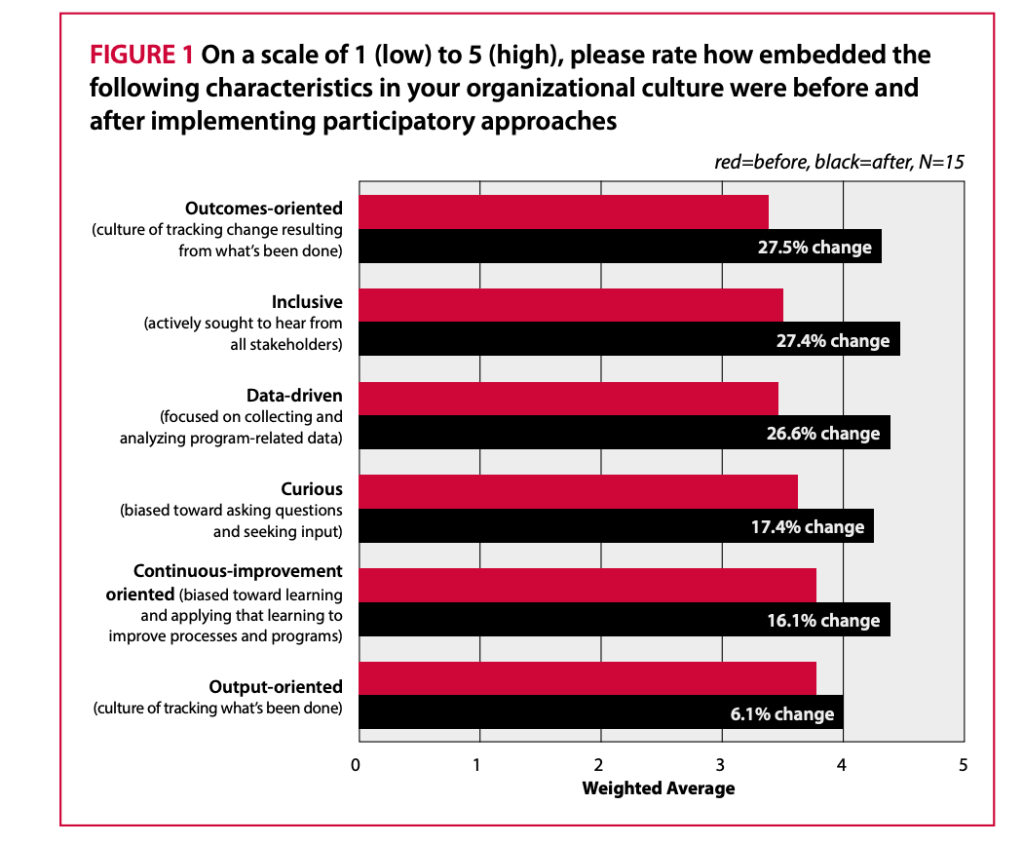
Building Evidence of Social Impact, a report by PACE and MilwayPLUS social impact advisors, examines a dozen nonprofits committed to continual participation of those served and found concrete outcomes from Constituent Feedback:

Why is Listening, Reflecting and Acting on Feedback Mission Critical? provides revealing strategies on the Pace Center’s process of sustained collaboration with marginalized youth to achieve organizational and policy changes.

Additional Resources:

Graphic credit: Charity Navigator

Leading Thinkers Rely on Young Minds

Are you shifting your mindset and organizational culture to recognize “the wisdom of youth” instead of the appreciative but patronizing “creative energy of youth”?

Change is afoot. In my third decade of working with nonprofits and government agencies as well as collaborating closely with hundreds of teen activists across the country, I detect several exciting trends. Many individuals and institutions that engage youth typically describe the “creative energy” and “idealism.” Now I’m hearing a very different mindset that emphasizes the “wisdom of youth.

I need to build structures in my life where I am routinely channeling and getting feedback, ideas and spirit from younger people…There’s a particular wisdom of youth–this generation has a very practiced sense of how to shift social norms, not just social media but a deeper awareness of how to change hearts and minds.

Eric Lui, CEO, Citizen University 

OXYGENATE

I know young people propel my own neuroplasticity and also know firsthand that young people literally oxygenate organizations.

It is our mission at Youth Infusion to encourage adults, especially those at the helm of organizations, to practice adaptive leadership that extends to being open to listening and learning with the rising generation. 

My contention is intergenerational interdependence is a win-win not only in terms of youth development but lifelong human development…reawakening the adventurous [spirit] and plasticity. 

Ronald Heifetz, Author, The Practice of Adaptive Leadership

DIVERSIFY

Not long ago it was rare for women, people of color and those with disabilities to share power with White men. It is ironic that in most organization’s DEI (diversity, equity and inclusion) initiatives, a quarter of the population continues to be excluded. 

Diversity needs to include diversity of age. I find people with fresh eyes, impatient eyes, angry eyes actually make you see things in ways that are very important. You need to be in constant touch with people who don’t think they belong…If you are isolating yourself from those with different energy you cannot be transformative in your work. 

– Angela Glover Blackwell, Founder, PolicyLink 

CURIOSITY

It is up to us–adults–to be genuinely curious so that young people believe we do not want adult clones but rely on them to ask the questions and explore solutions that most of us no longer dare ponder. 

The collective “we” need young people to be able to activate their imaginations…How does one keep an imagination firing off when we live in a nation that is constantly vacuuming it from them? And I think that the answer is, one must live a curious life. 

– Jason Reynolds, Author, Stamped: Racism, Antiracism, and You

As with any paradigm shift, there is a need to examine current attitudes, weigh different approaches, engage in careful preparation, pursue innovation and expect recalibration. Our multi-racial intergenerational team is eager and ready to help you and your colleagues advance to this new level and realize the ROI of Youth Infusion. Some of these intentional strategies are outlined below using the popular activity commonly referred to as Rose (something positive), Thorn (something negative), and Bud (promising concept).

I. SHIFTING ADULT ATTITUDES

Outside of one’s family and classrooms, interactions between young people and adults, especially senior and middle management, are rare. Age apartheid can cement long-held and outdated attitudes. Racial segregation may be another reason why adults have a narrow lens, failing to recognize Generation Z as the most diverse ever. 

PREVAILING VIEWS ABOUT YOUTH 
  • Rose – Youth, who may act less defiant than their peers and know how to code switch with adults, will hear slogans like “youth are the leaders of tomorrow.” Traditional mentoring is the norm. Youth influence typically is seen as limited to their generation. 
  • Thorn – The hot cognition button in the teenage brain reinforces frightening images. Impulsive or violent behavior persist as dominant stereotypes even though the data reveal most risky adolescent behaviors are at historically low levels
CHANGING MINDSETS ABOUT YOUTH 
  • Thorn – Adults may be unconscious of their own adultism that can result in protective or controlling behaviors which maintain unequal power dynamics. Supervisors and co-workers may opt for token youth engagement and resist shared decision-making. 
  • Bud – There is greater recognition that young people influence not only their peers but also parents, policymakers, the press. As minors, they can play major roles now. Presumed competence, combined with mutual mentoring and collegiality, represent this adult attitude adjustment.

One could boil down this changing mindset to a single philosophical preposition: “WITH” replaces doing “FOR” or “TO” youth.

II. TRANSFORMING INSTITUTIONS

Instead of thinking “IF” young people could be collaborators, switch the question to “HOW.” Of course, young people don’t jump on board until there is organizational readiness including new policies as well as carefully designed orientations for the newcomers along with adult staff. Our trainings and technical assistance introduce numerous options and we co-facilitate an 8-Step Youth Infusion Process. Here are a few general guidelines to progress from conventional youth engagement to synergistic systems. 

STICKING WITH TRADITIONAL YOUTH ENGAGEMENT
  • Rose – Youth advisory councils are commonplace at youth-serving nonprofits and schools. Many cities and states have established youth commissions. The emphasis focuses on youth development and leadership skills. Typically these advisory boards plan community projects, conduct surveys and youth participatory action research that may lead to formal recommendations.
  • Thorn – A major challenge is these advisory councils fail to attract marginalized youth most impacted and furthest from power. Ongoing exchange and collegial rapport between youth reps and adults at sponsoring institutions are limited. Typically youth are not encouraged to pursue systemic change and policy advocacy. 
ADVANCING TOWARD INTERGENERATIONAL SYNERGY
  • Thorn – Inertia maintains the standard work week that conflicts with the inflexible schedules of youth. The organization fails to engage in radical inclusion and maintains conventional practices that keep youth on the sidelines. Staff turnover may result in reversing commitment to a multi-racial intergenerational organization. 
  • Bud – Adaptive leadership, combined with a culture of curiosity and innovation, considers numerous strategies for infusing youth ranging from several part-time youth on staff to a cohort of consultants. Organizations adopt youth-friendly policies and intentionally expand DEIJ in recruitment and retention of BIPOC youth.

This intergenerational approach provides opportunities in the real world where young people share power with adults by contributing their insights and ideas from co-creation to advocacy and evaluation of programs and policies. The result: they prove their strength to themselves and the larger community. In return, dedicated professionals derive energy as young collaborators fuel new thinking and remedies that may have become stale to the adult world.

Every week we are learning more effective strategies for how individuals are transforming their nonprofits and agencies. We hope you will contact us to explore how to realize the full “Rosebud” and increase the impact of your organization. 

You Might Like…

Adults Devote Serious Support to Youth Police Reformers

Policymakers and other adult-led initiatives that are serious about collaborating with youth movements and community-based coalitions must reckon with how full-time staff and organizations need to commit the resources to ensure ‘Youth Voices’ is not just a feel-good slogan. 

How do you actually hear youth? A growing number of organizations pay lip service to ‘youth voices’ but never get past mottos and one-off events. We are learning how organizations actually listen and respond to perspectives, grievances, and solutions of the rising generation. This article explores how adults are making certain that ‘youth voices’ are front and center in the raging debates about policing on the streets and in the schools.

Policing Youth

The two initiatives featured here illustrate the monetary and pro bono support that resulted in real outcomes.

RESOURCES RESULTS
» City provided over $500,000 to garner experiences and proposed remedies from youth of all backgrounds.» Proposals by youth became the top recommendation by the city-appointed task force on police reforms.
» Adult volunteers and graduate students contributed over 100 hours to complete a comprehensive student police-free schools.
» School Board recommended to the Education Commissioner and Governor to enact the student coalition school safety plan.

Central Youth Role: Police + School Security Policies

The city of Oakland, California established the Reimagining Public Safety Task Force responsible for reallocating 50% of the $150 million Police Department budget. The 17-members included youth members, Ivan Garcia and Losaline Moa. Together with two key adult allies, they advocated successfully for extra Task Force funding of  $532,200 for a “citywide youth leadership strategy that authentically partners youth to participate and engage with decision makers at the highest level.” 

IMPACT:  Surveys, listening sessions, the “Black Youth Thought Wall,” and other outreach required money and staff support (Reimagining Public Safety Final Report and Recommendations see pages 61-63). This structured ‘youth voice’ process had a decisive influence that is evident in the Task Force Tier One Recommendations (see page 12) that include reallocating money for alternatives to criminalization, mental health services, etc. The City Council voted unanimously but has yet to fully fund all these proposals.

In Rhode Island, several youth-led nonprofits have been relentless in their Counselors Not Cops campaigns. To get more traction, five of these organizations formed a coalition, boosted by crucial support from a cadre of researchers at Brown University and other allies including the Center for Justice.

Recently released is the Providence Alliance for Student Safety Plan. Their comprehensive proposal, enhanced by testimonials by students and educators, calls for the elimination of all school resource officers and maps out a $8million to $9million line-by-line budget for social workers, psychologists and other positions at each Providence high school

IMPACT: In response to this long-term advocacy, the Providence Board of Education recommended to the Governor and Education Commissioner to eliminate all school resource officers from the largest school system in Rhode Island. More student walkouts are expected to pressure the Governor who publicly opposes police-free schools. 


Real Reform No More Token Gestures

Both reports deserve a deep read but one fundamental shift is the Providence Alliance for School Safety explicitly rejects the typical role of students having the proverbial ‘Seat at the Table.’ Instead students, especially those impacted by the school-to-prison pipeline and under-represented, need to be deciding ‘What’s on the Menu.’  

We Deserve and Demand Student Voices at the Lead — We propose that the District vest control over student safety and accountability in a committee of Youth Advocates and community allies, selected by youth. This youth-led committee will have control over school safety–abolishing punitive disciplinary policies, defining the actions schools will take to address disciplinary issues without the intervention of police, and guiding the design and implementation of transformative justice policies.

Providence Alliance School Safety Plan

Milly Asherov, a rising senior who works at the Providence Student Union as the Leadership Co-Director, is still exhausted from the coalition’s weekly Zoom meetings. She recognizes one major success factor of this four-month marathon project is symbiosis. 

  • Students provided concrete insider knowledge that contrast the impact of campuses with school resource officers and those operating with school safety teams as well as trauma-trained mental health professionals. 
  • Graduate students devoted their research skills to scouring programs in other school districts, collecting stats, generating a budget with baseline salaries for counselors, restorative justice specialists, etc.
  • Adult allies dedicated over 100 pro bono hours compiling the information and intense writing with weekly Zoom meetings and ongoing consulting with students every step of the way.

“Youth were present in all interviews with partnerships that could contribute solutions to school safety and all decided by youth. The adults were always checking with us to make sure every section of the report reflected our voices and understood our role in this plan was not just to edit grammar in the report.”

Milly Asherov, Classical High School Class of 2022

Adults Are Allies + Accomplices

Adults in California who advocated for significant resources ensured the two youth members were not token representatives on the 17-member Reimagining Public Safety Task Force. Half a million dollars resulted in very substantive input from young people across the city that paid for facilitators, stipends for participants, and staff who worked the youth members in similar fashion to those city employees who assisted the 15 other Task Force members. 

In Rhode Island, the hours of research and writing required to generate the Providence Alliance for School Safety plan depended on the intense involvement of dedicated adults. The hardcore reality is even students with superb time management skills rarely have enough free hours or flexible schedules to take such a behemoth project with significant support.

Policymakers and other adult-led initiatives that are serious about collaborating with youth movements and community-based coalitions must reckon with how full-time staff and organizations need to commit the resources to ensure ‘Youth Voices’ is not just a feel-good slogan. 


Contact us to explore how your organization or agency make youth exclusion a relic of the past!

You Might Like…

Elsewhere Online