Election Lessons for Every Organization

– Wendy Schaetzel Lesko

Profound lessons emerge from Zohran Mamdani’s victory even though NYC is unlike any other city. A historic turnout and a whopping 78 percent of those under age 30 voted for Zohran Mamdani. Sure, he is young, energetic, and charismatic, but I believe there is a broader conclusion that is relevant to any organization that recognizes the irreplaceable value of the rising generations. 

“The language with which we speak to young people is truly one of condescension… If you treat young people with the respect that they deserve then they will not be a part of your movement but the heart of your movement.”

Mamdani’s insight isn’t just about politics—it’s a wake-up call to every institution, nonprofit, and company that seeks to stay relevant and innovate. His words expose a persistent gap between how adults talk about young people and how rarely they talk with them. This “Youthquake” (Oxford Dictionaries’ Word of the Year in 2017), that powered his campaign did not happen by accident; it came from genuine listening, shared power, and the conviction that young people deserve to shape—not just support—the causes they believe in.

Cities have always been laboratories for democracy. In my recent article in the National Civic League’s magazine, I outline specific strategies for local government leaders to replace token youth engagement efforts. Read full article here. These lessons are magnified by Mamdani’s example. His victory demonstrates what becomes possible when young people are seen not as a “target audience” but as co-architects of civic renewal.

The election sharpens some of these approaches:

  • Demonstrate that young people are not too young to be critical thinkers
  • Amend the expression “meet them where they are” and instead meet their grievances and dreams head on
  • Make sure ideas emanating from “youth voice” does not continue to fall on deaf ears
  • Be relentless in learning from those young people who most impacted and unheard
  • Recognize the demand for urgency is not the negative stereotype of impatience that often sidelines young people
  • Replace empty rhetoric and broken promises with persistent and accountable action
  • Embrace “We are unstoppable, another world is possible!” 

Before the November 4 election, pollster John Della Volpe validated that people feel most campaign messages sound like scripts from a Human Resources department. Young people detect condescension in a heart beat. Yet the responses from these young NYC voters offer a poignant counterpoint and a hopeful challenge: h

“We’re hopeful — and just ready for some new love and spaces.”
“We still care. We’re just not represented.”
“We’ve been through a lot. But we’re still trying to be part of it.”
“We are the generation that will be talked about for generations.”

These are not the words of apathy or disengagement. They are an invitation—a plea—to rebuild trust through authenticity, shared purpose, and visible collaboration. Whether the context is an election, a nonprofit boardroom, a classroom, or a city hall, the message is the same: young people are paying attention. They are measuring not our slogans but our sincerity, not our outreach but our willingness to share real power.

Mamdani’s landslide is more than a political milestone; it’s a generational mirror. It reflects what happens when young people are not merely courted during campaign season but centered in year-round decision-making. Every organization, regardless of mission or size, can draw from this moment a simple yet profound truth: when young people feel truly seen, heard, and valued, they don’t just show up—they show the way forward.

Photo credit https://www.thecivicscenter.org

The Hidden Cost of Ignorance: Understanding Youth Perspectives

It probably sounds crazy but think about the benefits of “not knowing what you don’t know.” Understanding the full scope of an issue takes years and over time, that expertise can fence off the most basic questions and unconventional ideas. 

If those who possess such “wisdom” genuinely absorb the perspectives of aspiring young changemakers, this intergenerational collaboration can oxygenate the novices and experts. 

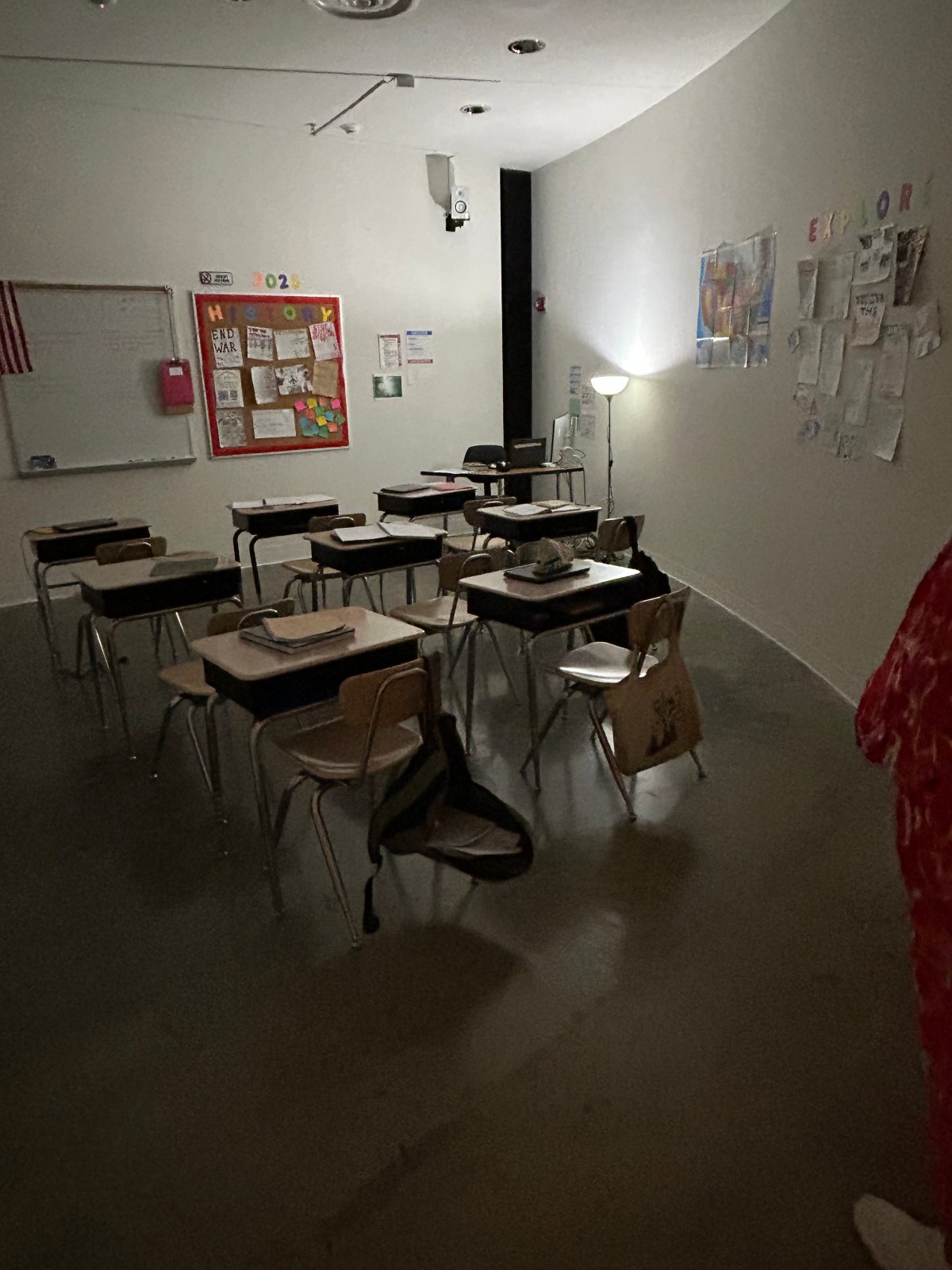
See how you react to “The Classroom, 2025,” exhibited by the Museum of Contemporary American Teenagers. Do you feel your synapses responding differently as you read the abstract of this art installation created by Alex Weiss, Mia Melton and Lois Proeller? (The photo above does not include the sound with the school announcing a drill.)

“My first lockdown was in elementary school. I was 8. We all hit in a corner, confused, scared, and not yet understanding that this would become all too normal. From the time my peers and I entered elementary school, we participated in various safety drills: Fire drills, weather drills, and shooting drills. We learned how to make a classroom look empty and how to find the best places in the room to hide. We grew up in a culture where school shootings were a regular risk of going to school. 

It isn’t fair that our learning environment should come with a danger of death every single day. We beg for help and are ignored and when something horrific happens, all we get are “thoughts and prayers.” We don’t get change. We don’t get safety. We get politicians with their heads in the clouds. We get adults too obsessed with their Second Amendment rights to realize that their stubbornness is killing kids.

I hope that with this installation, adults can at least understand a fraction of what students have to go through. This is our reality, 12 years of our childhood. A constant and looming threat of mortality shrouds our foundational years.  In a lockdown, the walls close in and the classroom has never felt more like a jail cell. You look around at your classmates, not knowing if these are the people you’ll spend your last moments with.”

Especially issues that directly impact children and young people, it is almost unimaginable to make policies about them without them – especially because they don’t have a graduate degree! 

Please share your comments because the more perspectives the better!

– Wendy S. Lesko

Let’s Recharge Our Batteries Together

All the chaos, cruelty, and cynicism can make it tempting to retreat to familiar surroundings and friends—often people your own age who may share similarly dystopian views. But I’m continually refueled when interacting with much younger minds, especially when talking about how “the world sucks.” These conversations may not always delve into history or generate profound insights. Instead, they offer a chance to see the world through different eyes. That wider lens reignites my brain.

Most organizations—often due to legal concerns—don’t bring people under age 18 into the heart of their operations. But there’s a rising tide pushing back against the idea that professionals and experts should substitute for the lived expertise of young people themselves.

“I am not becoming. I’m not in the making. I’m a full human being with thoughts and creativity and wisdom to offer.”
— Evelyn Monje, first high school employee hired by UP for Learning

Instead of being a burden, intergenerational collaboration uplifts everyone—from senior leaders to junior staff. Sophia Montemayor of Healthy Futures of Texas puts it best: “I genuinely love this work.” She describes her young collaborators as “battery chargers” and adds, “the evening meetings with these high school students make me forget how much I like to be in bed early.”

How can we help one another experience this same boost and joy? Light hearted and serious resources alike can offer strategies to navigate the complex dynamics of engaging young people in ways that enhance both credibility and effectiveness.

Will You Share Your Favorites?

We are collecting resources in all kinds of formats, including:

  • Google slide(s) with a compelling quote or graphic
  • IG post
  • YouTube video
  • Podcast or webinar
  • Article
  • Toolkit
  • Book or dissertation

Please use this link to contribute your recommendations.
If your submission is included in our forthcoming 25 Cool Clever Youth Infusion Resources in 2025 (working title), you’ll receive a free copy!

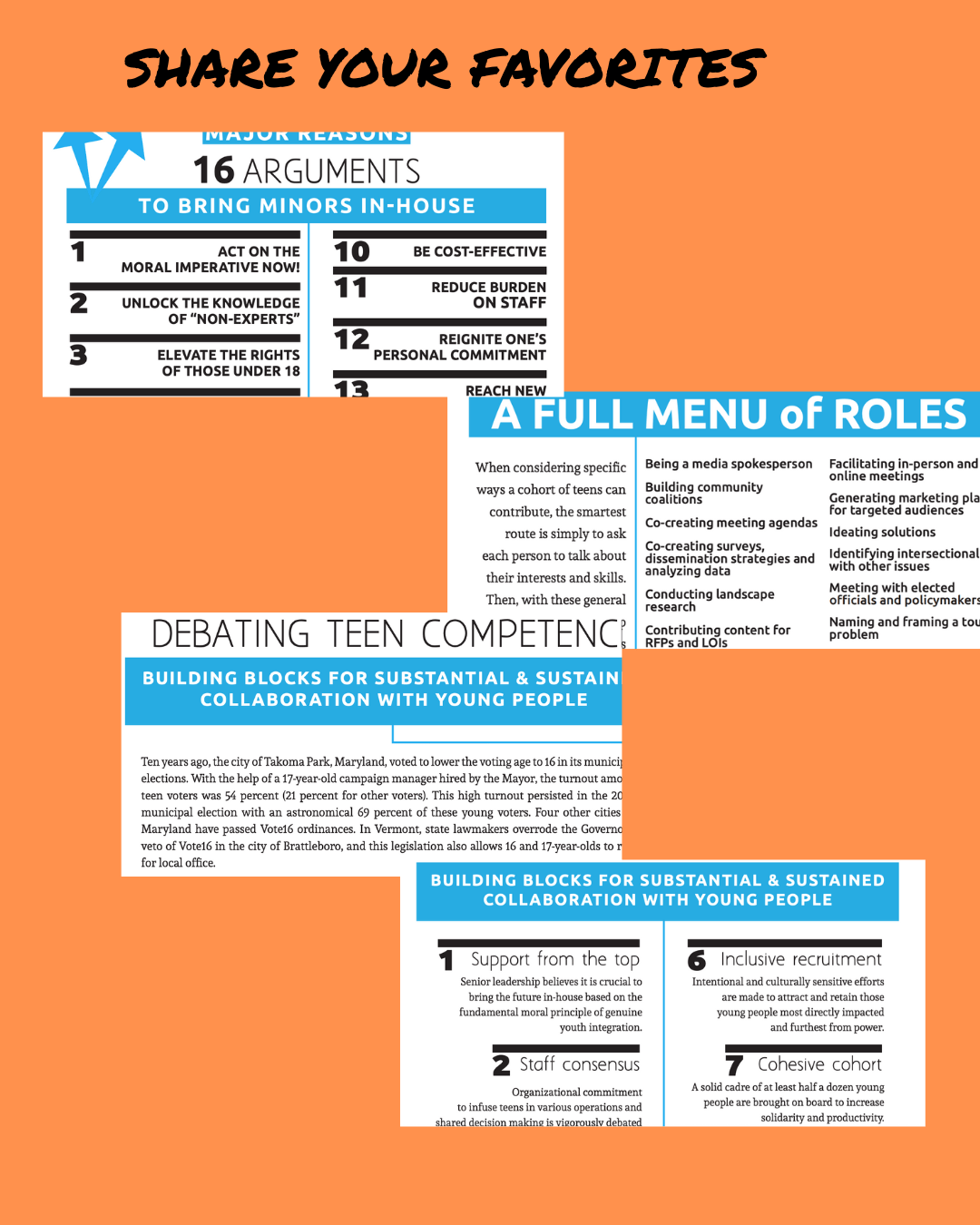
In the meantime, here are several of our one-pagers:

16 ARGUMENTS TO BRING MINORS IN-HOUSE

A FULL MENU OF ROLES

DEBATING TEEN COMPETENCE

16 CORE COMMITMENTS

Don’t keep your go-to resources to yourself—send them our way and help ignite a movement that values young people not just as future leaders, but as present-day partners. Many thanks! Wendy

Countering the Culture of Hate: Your Role Matters!

Does hate seem louder and meaner to you? It’s flailing in all directions. Can we address this human frailty before it infects more of us?

This fever of hate worsens the lives of those who have long been targets—today, teenagers are among the most affected. As the most diverse generation in history, few teens escape this widespread antipathy.

Experiences of being denigrated or demonized often become internalized. Like other forms of abuse, feelings of inferiority and discrimination mutate and pass through generations.

Even unconscious negative attitudes toward teenagers are reinforced daily by the ongoing narrative vilifying “kids today.” Ellen Galinsky’s research in The Breakthrough Years reveals that only 14% of parents use positive words to describe teens. Additionally, just half of adults recall positive memories from their own teenage years, perpetuating a tradition of scapegoating.

Despite a growing emphasis on “youth voices,” the vast majority of teens don’t believe they are liked and their ideas are discarded.

Exclusion: Another Consequence

Hate also fosters exclusion. Many adults have limited interactions beyond their family circles, which reinforces stereotypes and limits opportunities for understanding and collaboration.

Adults often keep their distance from teenagers, attributing angst, ignorance, or arrogance to the entire group. While there appears to be a wealth of opportunities for young people, the reality is sobering.

  • Only 2% of high school students complete an internship each year, according to American Student Assistance.
  • The U.S. Department of Labor estimates only about 10,000 16- to 18-year-olds start an apprenticeship each year.

The absence of intergenerational collaboration in the workplace hurts everyone.

The temptation to generalize based on generational labels is hard to resist. To address this issue, the Pew Research Center has opted to move away from rigid generational classifications.

“By choosing not to use the standard generational labels when they’re not appropriate, we can avoid reinforcing harmful stereotypes or oversimplifying people’s complex lived experiences.”

Dare I Ask . . .

Many adults exhibit reprehensible speech including high-profile leaders like President Trump. I wince when hearing “Where are the adults in the room?” We all know young people-even those in elementary school-who are skilled in conflict resolution and restorative practices. Maybe the presence of young people would cause adults to behave better.

Strategies to Break the Hate Habit

Reducing this negativity requires intentional effort. Addie Lentzner, a mentor of mine, offers this perspective:

There is an entire community that makes up our world that is not being accurately included due to our internalized biases about what they are capable of. It is up to all of us to design organizations and structures WITH young people for the benefit of ALL.

Here’s what I strive to do daily: respond to sweeping generalizations with a light but firm touch.

> A friend complained about her babysitter being glued to her phone and lumped all young people together. I replied, “It sure seems that way but I know many teens who maintain great eye contact during conversations.”

> A colleague remarked that “kids have so much free time and waste it” I countered, “That’s true for some, but many work after school and also take care of their siblings.”

The goal is to coach adults to pause and watch out for their deeply conditioned thought patterns before falling into the hate trap.

After years of collaboration with teenagers, here are a few of their recommendations:

See me as an individual

Don’t stereotype

Don’t treat me like your child

Avoid insulting compliments

Be open-minded

Admit you don’t have all the answers

Feel the urgency we feel

Don’t judge

Talk with us, not at us

Keep unlearning and relearning

Laugh with us

Respect us

 It’s oppressive to call us “children” and “kids” because it has a negative connotation that is not empowering to us so we’d like to be referred to as “youth.” 

– Salina Shamsuddin, Bridges USA’s Youth Justice Council


Hate affects us all. Breaking this cycle starts with catching ourselves—and those around us—when negative comments arise. Respect for one breeds respect for all. Together, we create a culture that promotes curiosity and collaboration.

How to Avoid Mistakes with Staff Who Work with Young People

Imagine this scenario: You’re preparing to deliver a presentation to the senior executive team or Board of Directors. You’re likely running through a practice session, making last-minute tweaks to your slides, and bracing for tough questions.

Now, picture a different audience—25 teenagers you are meeting to invite into a policy advocacy campaign. Beyond the logistical headaches, your attention shifts to designing the opening minutes to set everyone at ease and introducing the issue in a captivating way. Then comes the carefully planned yet flexible choreography of interactive activities, culminating in actionable next steps. Ideally, you would  co-facilitate with a young person, dedicating ample preparation time to create a participatory atmosphere with the right balance of content and hands-on action.

Unlike a pitch to your colleagues, where even lukewarm reactions are manageable, presenting to teenagers can feel like performing as a comedian whose jokes fall flat.

As Crystal Oceja with Bridges USA and Stand for Children Tennessee explains:

“The adults approach you with no authoritative energy. They are very open. They are cool. They check in. They don’t force you to do anything.”

Skills Learned + Earned

Most professionals—especially policy experts—rarely interact with young people in their workplace. This disconnect often prevents them from fully appreciating the skills required to engage with youths. This gap in understanding extends to teachers, school counselors, social workers, YA librarians, and others. With over 70 million people under 18 in the U.S., only about 2.5 million individuals hold specialized degrees in youth work from higher education institutions.

The skills needed to work with young people are unique, distinct from those of parents or authority figures. Building trust and rapport at the initial make-or-break stage is crucial. It often requires embracing radical ideas and patiently discussing proposed programs, services, legislation—even those proven ineffective. One invaluable skill among these staff is what I call “a third ear.” This heightened listening skill goes beyond hearing, delving into curiosity and imagination, encouraging even the most timid young people to open up and share. It’s rare for such open dialogue to happen naturally, especially in intergenerational settings. One test is when young people laugh and joke alongside adults decades their senior, erasing hierarchical barriers.

Take Carolyn Cox, who runs  a Medicaid-supported program in Washington that trains and pays young people to become certified peer counselors. One Board member aptly describes her unique talent:

“Carolyn creates this aura because young people know she really lets them be themselves, lets them feel, and lets them speak.”

Working with teenagers—whose primary job is school and who often juggle family responsibilities—requires artful agility. Consider a 16-year-old managing health issues while preparing for an interview with a reporter. The pressure of deadlines and anxiety might make them want to quit. Supporting them through such challenges takes patience, empathy, and flexibility.

How Not to Undermine These Specialists

One of the most challenging aspects of this work is the lack of appreciation and respect from colleagues and/or executives. I recall a senior writer at a major magazine once commenting that I looked like a camp counselor because of my neon orange t-shirt, which featured a design created by a 17-year-old for our nonprofit’s national (victorious) grassroots campaign. This dismissive remark stung, reflecting the pervasive attitude that do not value those who collaborate in the new level of co-piloting with teens. 

Just as professionals must go the extra mile to gain the trust of young people, senior leaders should invest effort in understanding and recognizing the adults who work with them.

Plates are spinning in dozens of directions. For example, multiple campaigns involving hundreds of teens with the Kentucky Student Voice Team, which boasts impressive achievements in data analysis and policy advocacy. It’s co-founder and managing director Rachel Belin emphasizes that their co-designed work is “an art, not a science” and carries a “mental load” magnified by the actual and perceived legal liabilities of working with minors.

To recognize and respect these professionals, organizations can adopt intentional strategies, including

  • Allow flexible schedules to accommodate late afternoon and evening meetings, trainings, one-on-ones as well as weekend activities;
  • Assign a senior level staff person to act as a consistent liaison for those working directly with young people;
  • Seek technical assistance to help HR develop protocols for working with minors;
  • Include these employees who typically are low-level or junior staff in decision-making processes, validating their roles rather than sidelining them;
  • Consult these staff on how, not if, young people can be integrated into more organizational operations;
  • Ensure fair compensation for these youth specialists to reduce turnover and maintain the trust built with the youth cohort;
  • Encourage ongoing professional development through trainings, conferences, and networking opportunities that will help make youth representation the norm in nonprofits and government agencies. 

Share Your Experiences + More Info

Photo Credit:  UP for Learning

Booster Shot for Health Advocates

By Wendy Schaetzel Lesko

When it comes to the universe of health advocacy organizations, government agencies and private foundations, expertise is off-the-chart. One significant gap however is the first hand experiences and insights of those young people currently using services and equally crucial, those who cannot obtain vital information or access needed health care.  Symbiosis between the professionals and those under age 18 holds the possibility of significant breakthroughs. 

“We don’t want to lose them to CVS!.” 

-Michele Perlman, Assistant Vice President for Education and Training,  Community Health Network

Let’s look at the diabetes epidemic and tooth decay.  Denise Webb, now age 20,   with whom I proudly and joyfully co authored Why Aren’t We Doing This! Collaborating with Minors in Major Ways, are five decades apart and our lives are vastly different. 

Both of us have battled against the predatory marketing practices by the behemoth beverage industry.  While working with the Youth Activism Project, I collaborated with a diverse cadre of teens including one with diabetes. They demonstrated unique influence capturing media attention and had irreplaceable impact with elected officials that resulted in a county ordinance restricting the sale of sugar-sweetened beverages  (SSBs) in vending machines.  

Denise has sharpened her toolkit of skills during the four years she has worked part-time with the Partnership for Southern Equity (PSE). The Oral Health Disparities Project ranks as one of Denise’s most meaningful efforts with this nonprofit that is also the headquarters for Coke Cola. 

Encourage These Experts to Challenge

Thinking back to her  childhood, she reminisce about “ walking to the convenience store for that absolutely favorite 99 cent peach soda.” Collaborating with PSE Just Health Workgroup, the professionals make certain their teen colleagues are not token advisors. The result is genuine intergenerational interdependence.   For example, Denise and other Youth Staff pushed back on the plan by the communications staff to create social media flyers, Instagram live broadcast, etc.  Instead they developed an alternative photovoice strategy in specific neighborhoods which became an effective digital campaign. From fun in-person interviews to heart-breaking community documentaries, the input of the young advocates shaped and propelled the way adults viewed health equity and policies in communities. 

Data collection was another core deliverable of this Oral Health Disparities grant and the Youth Staff were credited with adding another survey question: “Do you live near a convenience store?”  The responses revealed glaring differences between zip codes which informed the Workgroup’s recommendations to address both dental disease and food deserts. Denise emphasizes that this health issue would not be on “Teens’ Top 10 Concerns” but the sincerity and reliance of the professionals were what unleashed her passion to apply their own lived experience and 21st century skills.

Our Youth Staff are not an afterthought, not our guinea pigs or focus group. They are in the work and I’m really excited about that. 

– Robyn Bussey, Just Health Director with Partnership for Southern Equity

Multiple strategies to recruit those most impacted and furthest from power along  with numerous approaches regarding onboarding, one-to-ones, compensation and other essential intergenerational commitments are described in our 160-page book. Also, don’t miss Denise Webb’s five-minute speech  at an international health conference in Catalytic Credibility + Clout of Young Advocates/.

Photo credit: Partnership for Southern Equity

Unlock Knowledge of Those Impacted by the Juvenile Justice System

What happens when authoritative energy is replaced by authentic intergenerational symbiosis.

“The real crime lies in how society views us.” 

This indictment by a young individual cited in a report by the Shelby County Youth Council in Memphis stings because it is true. 

Activists of all ages in Shelby County have no illusions about dislodging deep systemic racism but they demonstrate increasing impatience about how minors are mistreated in the largest county in Tennessee. 

Salina Shamsuddin with the Youth Justice Action Council did not mince words with me when talking about how grownups need to behave.

 It’s oppressive to call us children and kids because it has a negative connotation that is not empowering to us so we’d like to be referred to as youth … Catching them [adults] and standing up for ourselves is one of the biggest things that work and people really understand they cannot treat us like this anymore.  

The Youth Justice Action Council (YJAC) centers its work on those impacted by the juvenile justice system in Memphis. At age 14 Crystal Oceja, whose “brother didn’t get treated with humanity,” helped develop 10 legal demands in its “Break the Chains” written petition and rap version. YJAC used these specific demands in its campaign to defeat the District Attorney and Juvenile Court Judge who tried many Black and Brown youth as adults.   

Following this victory, the Youth Justice Action Council hosted a forum for the newly elected Judge,  DA and law enforcement.  In small groups, two YJAC members shared their firsthand stories about the juvenile justice system and one of the other Council members facilitated. Adults were told not to interrupt or interrogate.  Another one of the facilitators, Milana Kuma emphasized

… the need to center on the experiences of systems impacted youth as opposed to just recommendations. It’s harder to invalidate when they [DA and others] are faced with the trauma they have caused and cannot distance themselves.

Marshawn Jenison, 16, summed up: “I feel good about actually being heard. Nothing negative back. They are trying to understand how we really feel and what is really going on.” 

One Youth Justice Action Council representative serves on the five-member Shelby  Countywide Juvenile Justice Consortium, all appointed by the Mayor. This is not a token position. In fact, this rep and the YJAC have credibility and clout plus strong rapport with the adult members.

I don’t think we’ve ever made a decision that has not had a youth voice…They are our checks and balances. We are really led by them.

Rebecca Davis, Chair of Countywide Juvenile Justice Consortium

The Youth Justice Action Council is sponsored by Stand for Children Tennessee, which advocates for racial justice and improving public education. A 100-year-old organization in Memphis, appropriately named Bridges USA, lives and breathes by its deep commitment to youth-adult equity. Crystal, now 16, captures this rare intergenerational symbiosis. 

The adults approach you with no authoritative energy. They are very open. They are cool. They check in. They don’t force you to do anything.

There’s a bit of disbelief that systemic change can actually happen. Even with the horrific murder by police of Tyre Nichols, the recent election fuels the determination of these young advocates erase the superpredator view that Mike Males debunks in The Terrifying Plunge of Youth Crime published at YouthFacts.org.

Recap:

Bridges USA

Countywide Juvenile Justice Commission

Shelby County Youth Council Youth Voice Report

Stand for Children Tennessee 

YouthFacts.org

Youth Justice Action Council

Photo Credit: ABC24

Do You Have These 10 Critical Character Traits?

Building a collegial partnership with teens is altogether different from the traditional power dynamics so common with a parent, educator, or authority figure.

When introducing the concept of infusing teens into various organizational operations, the flood of reactions from most adults is predictably negative. 

My nephew is obsessed with online gaming. 

My friend’s 16-year-old daughter is so lazy and clueless. 

These kids don’t want to have anything to do with us. 

This crime wave . . . I’m scared of them. 

Adults must take off their hat as a parent, aunt, educator or other authority figure to see each young person as an individual. To unlock the minds of the rising generation to imagine a better society, analyze problems, and develop strategies to pursue real change together, the responsibility rests with adults to demonstrate authentic respect and build genuine rapport. A collegial partnership is altogether different from the power dynamics so common with a mom or dad, teacher or principal, etc. 

  Encourage us. Build on our ideas. That gives us the confidence we need.  – Melissa K.

Essential Soft Skills for Sustained Collaboration

  1. Optimist – Hold onto hope as the antidote to cynicism
  2. Listener – Develop a “Third Ear” to be open to new thinking
  3. Learner – Keep your imagination faucet open
  4. Advocate – Share your own pragmatic idealism 
  5. Communicator – Text or talk 1:1 outside of meetings 
  6. Comedian – Joke and laugh
  7. Infomaniac – Explain relevant organizational efforts and future plans
  8. Choreographer – Connect teens with other staff and organizations
  9. Honest Broker – Establish feedback loops to respond to ideas
  10. Catalyst – Implement proposals as quickly as possible to show change happens

The passing of my very dear friend and wonderful colleague inspired this list of character traits. Pat Moore Harbour, PhD possessed them all. She served as the catalyst for my involvement with one of the Kettering Foundation’s Research Learning Exchanges that builds off her book, Community Educators: A Resource for Educating and Developing Our Youth

Contagious Curiosity

Given my dogmatic and persistent nature, I challenge the prevailing mindset of adults doing “to” and “for” youth. Pat and I had dozens of conversations where she showed such respect and curiosity about my approach that young people be recognized as wise community educators, influencing their peers as well as adults and the community at large. Instead of viewing youth as “under construction,” we often talked about our kinship with older colleagues who are committed to anti-ageist multi-racial collaboration. 

When discussing the concept of youth infusion – especially those under age 18 – in adult-run nonprofits and government agencies, Pat always was intrigued and honest. Her sense of possibility led her to emphasize the role of young people as “co-producers.” She embraced collaboration “with” youth – the key preposition and title of the recent book by David Mathews, founder of the Kettering Foundation (read more about WITH  here).

I was eager to discuss with Pat these two studies that conclude most adults lack her curiosity and interest in intergenerational interdependence. She would have shared her contagious optimistic outlook. 

Every conversation with Pat was a joy. Children laugh 300 times a day and the average for adults drops to only 15. She had me laughing and rethinking all the time.

Many of my closest friends and colleagues are not open to this concept of engaging with teens as genuine thought partners but I will not give up because of Pat’s spirit that will endure. How fortunate I am to carry Pat in my head and heart!

Photo credit: Dr. Pat Moore Harbour