

Young people have long been early adopters of emerging technologies. Just as many teens developed an intuitive fluency with the internet and social media, their instincts about generative artificial intelligence may shape how the rest of society adapts. One leading AI executive recently predicted that those who are “instinctive” with AI models will be in high demand, even as many entry-level jobs disappear.
Two recent national surveys of Gen Z reveal strikingly similar findings. Given the rapid evolution of AI, this data offers early signals about where attitudes—and behaviors—may be headed.
A study by HOPELAB, highlighted in my Top 25 Must-Have Free Youth Infusion Resources, examines youth perceptions of AI. Especially insightful is the section in this report titled “What Teens Say Adults Should Know About Their Uses of AI.” Teens describe AI as a “non-judgment zone.” That insight alone speaks volumes about why young people turn to these tools—and what adults often misunderstand. One teen noted that AI presents and explains information “better than most adults.”
At the same time, attitudes remain fluid. A new report from the Pew Research Center finds that Gen Z leans slightly positive overall, with many expressing the belief that “AI is the future.” Yet HOPELAB’s data reveal more nuanced differences: LGBTQ+ youths are more likely to anticipate negative impacts from AI in the next 10 years.
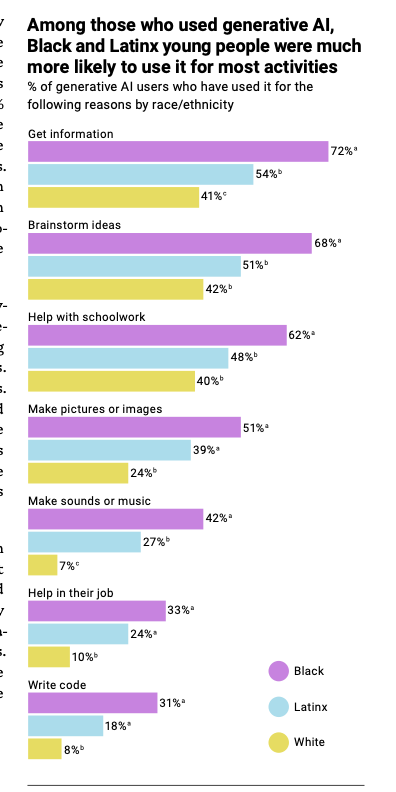
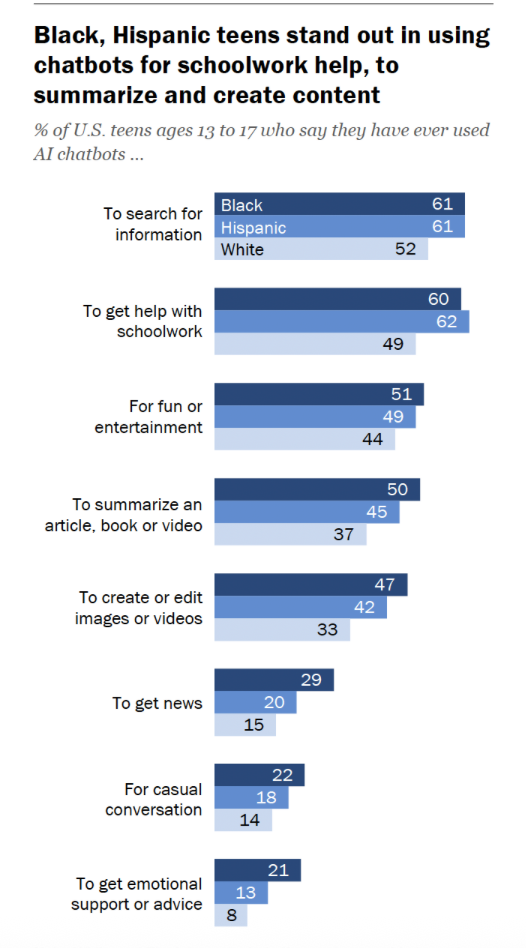
Surprisingly, both studies report that teens most commonly use AI for seeking information and brainstorming—not primarily for schoolwork. As one young person put it:
“We use it for very creative purposes, not just cheating on homework.”
HOPELAB survey finds:
Pew Research also sees similar demographic patterns:
Early Signals for Schools, Nonprofits, and Policymakers
A decade ago, sweeping assumptions labeled all young people “digital natives.” Today’s AI narrative risks repeating that mistake. Not all teens are active AI users, and many report feeling social “pressure” to keep up with this new technology.
AI does not yet appear to be fully integrated into most Gen Z lives, which may explain why privacy concerns currently hover below 25 percent in some surveys. Future research will likely probe more deeply into data-sharing anxieties and environmental questions surrounding energy-intensive data centers.
Even if schools attempt to sharply restrict AI use, the genie is out of the bottle. Consider students who quickly outmaneuvered districts that require phones to be locked in Yondr pouches. This student editorial calls out the waste of $7 million by the Los Angels Unified School District.
“A policy that promised to transform school culture instead revealed how out of touch district leadership really is.”
Once again, the lesson for schools, community organizations, nonprofits, and government institutions is clear: the sustained and substantive involvement of diverse young people in co-creating AI policies and programs is not optional.
If AI represents the future, youth foresight must help shape it.
If AI represents the future, youth foresight must help shape it
Additional Information
- Boston Children’s Digital Wellness Lab Pulse Survey 2025 – Breaks down digital ecosystem (messaging apps, gaming environments, social media platforms, etc) https://digitalwellnesslab.org/wp-content/uploads/DWL_Pulse_Report_Belonging_Dec-2025.pdf#page=8.99‘]
- HOPELAB – data included from a separate survey by Center for Digital Thriving and Common Sense Media with open-ended question asking people between the ages of 13-17 https://assets.hopelab.org/wp-content/uploads/2024/05/Teen-and-Young-Adult-Perspectives-on-Generative-AI.pdf
- Pew Research Center – data from nearly 1,500 dyads comprised of one 12117 year-old and one parent https://www.pewresearch.org/internet/2026/02/24/how-teens-use-and-view-ai/
- Top 25 Must-Have Free Youth Infusion Resources. Free download https://youthinfusion.org/sign-up-for-25-must-have-free-youth-infusion-resources/
Photo credit: AI generated image

 Youth Infusion