IGNITING IDEATION WITH YOUNG PEOPLE

You know when young people are asked for solutions to a complex community issue, their ideas often fall into one of two categories: proposals that simply tweak existing programs, or at the other extreme, radical reforms. Experts and seasoned professionals can become frustrated by what they perceive as a knowledge gap—ideas that seem either too incremental or too far-fetched.

But emerging neuroscience reveals a powerful new method for helping young people gain a wider lens—one that ignites deeper ideation. Although this research targets educators, it’s highly relevant for any organization that relies on younger minds to imagine fresh solutions.

“Transcendental adolescent thinking” may sound like the latest meditation trend, but it deserves serious attention from anyone trying to harness young people’s unique perspectives and innovative problem-solving capacities. It supports my recommendation to delay skill-based training and instead first invest time in expanding a young person’s aperture of exposure—beyond their immediate ecosystem.

Especially in an age when AI delivers information in the flicker of a second, this research carries even more weight. Mary Helen Immordino-Yang, a professor of education, psychology, and neuroscience at the University of Southern California, conducted a remarkable study with 65 low-income individuals between the age of 14 to 18 from high-crime neighborhoods. She spent two hours—yes, real time—with each participant as they watched 40 compelling true stories and then they discussed “how did that story make you feel?”

This broad infusion of human experiences produced strong “transcendental thinking…beyond the here and now” – outside their firsthand experiences and assumptions. Two years later, this same cohort remained deeply motivated to contribute to their communities. As young adults, they reported high life satisfaction.

Watch a short overview of her work.

This level of intentional information sharing and reflection is something people of all ages could benefit from. Here are several impacts of this cognitive processing among young people.

Read the full research article.

(i) SYSTEMS-LEVEL ANALYSIS or moral judgements, or curiosities about how and why systems work as they do, e.g., “I also find it unfair that the people get undocumented. It’s kind of weird how it’s like a label how like just ‘cause you are from some other place, um, you can’t do certain things in another place. It’s like a question.It’s like something I’ve always wondered…”;

(ii) DISCUSSION OF BROAD IMPLICATIONS and morals and moral emotions, perspectives, personal lessons or values derived from the story, e.g., “I think back to the idea that because children are the future […] we have to be able to inspire people who are growing and have the potential to improve the societies”;“it makes me happy for humanity”;or

(iii) ANALYSIS OF THE PROTAGONIST’S QUALITIES of character, mind, or perspective, e.g.,“[she is] thinking, ‘oh, you’re not alone. You have others who are dependent on you’.”Importantly, it was not relevant whether the participant endorsed a value or lesson or agreed with the protagonist, e.g.,“I wouldn’t react that way. I’d just be really mad at the kid instead of, you know, selfless like that and trying to help him. Like I wouldn’t be able to put myself in someone’s shoes like that like he did.”

The potential for intergenerational collaboration is immense. A workshop or brainstorming session will not reach this high level of emotional engagement and cognitive output. Please share how your nonprofit or government agency is experimenting with this type of knowledge exchange with much younger minds who see the future in ways adults cannot fathom. The result is everyone gains a wider lens.

— Wendy S. Lesko

The Hidden Cost of Ignorance: Understanding Youth Perspectives

It probably sounds crazy but think about the benefits of “not knowing what you don’t know.” Understanding the full scope of an issue takes years and over time, that expertise can fence off the most basic questions and unconventional ideas. 

If those who possess such “wisdom” genuinely absorb the perspectives of aspiring young changemakers, this intergenerational collaboration can oxygenate the novices and experts. 

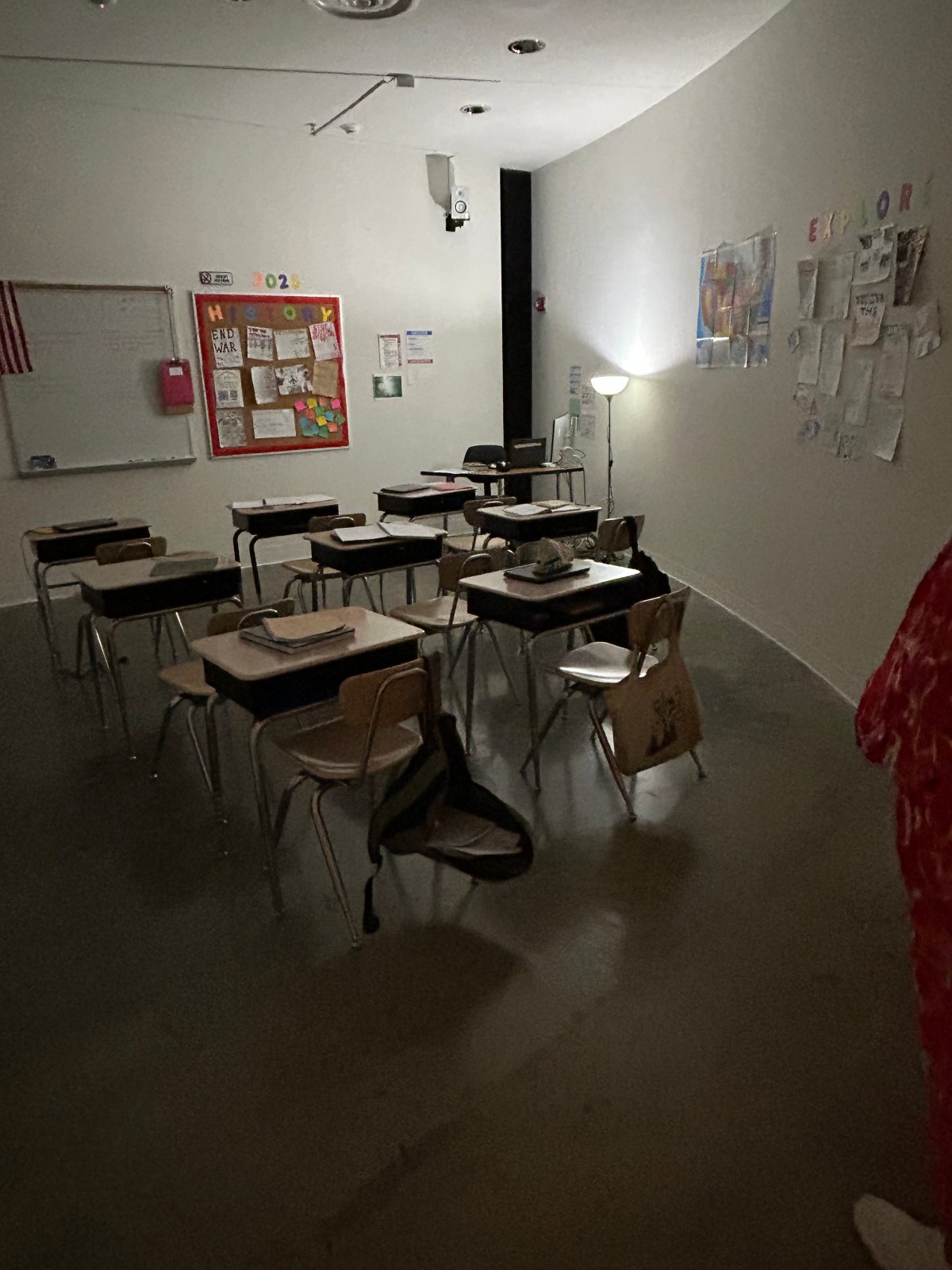
See how you react to “The Classroom, 2025,” exhibited by the Museum of Contemporary American Teenagers. Do you feel your synapses responding differently as you read the abstract of this art installation created by Alex Weiss, Mia Melton and Lois Proeller? (The photo above does not include the sound with the school announcing a drill.)

“My first lockdown was in elementary school. I was 8. We all hit in a corner, confused, scared, and not yet understanding that this would become all too normal. From the time my peers and I entered elementary school, we participated in various safety drills: Fire drills, weather drills, and shooting drills. We learned how to make a classroom look empty and how to find the best places in the room to hide. We grew up in a culture where school shootings were a regular risk of going to school. 

It isn’t fair that our learning environment should come with a danger of death every single day. We beg for help and are ignored and when something horrific happens, all we get are “thoughts and prayers.” We don’t get change. We don’t get safety. We get politicians with their heads in the clouds. We get adults too obsessed with their Second Amendment rights to realize that their stubbornness is killing kids.

I hope that with this installation, adults can at least understand a fraction of what students have to go through. This is our reality, 12 years of our childhood. A constant and looming threat of mortality shrouds our foundational years.  In a lockdown, the walls close in and the classroom has never felt more like a jail cell. You look around at your classmates, not knowing if these are the people you’ll spend your last moments with.”

Especially issues that directly impact children and young people, it is almost unimaginable to make policies about them without them – especially because they don’t have a graduate degree! 

Please share your comments because the more perspectives the better!

– Wendy S. Lesko

Let’s Recharge Our Batteries Together

All the chaos, cruelty, and cynicism can make it tempting to retreat to familiar surroundings and friends—often people your own age who may share similarly dystopian views. But I’m continually refueled when interacting with much younger minds, especially when talking about how “the world sucks.” These conversations may not always delve into history or generate profound insights. Instead, they offer a chance to see the world through different eyes. That wider lens reignites my brain.

Most organizations—often due to legal concerns—don’t bring people under age 18 into the heart of their operations. But there’s a rising tide pushing back against the idea that professionals and experts should substitute for the lived expertise of young people themselves.

“I am not becoming. I’m not in the making. I’m a full human being with thoughts and creativity and wisdom to offer.”
— Evelyn Monje, first high school employee hired by UP for Learning

Instead of being a burden, intergenerational collaboration uplifts everyone—from senior leaders to junior staff. Sophia Montemayor of Healthy Futures of Texas puts it best: “I genuinely love this work.” She describes her young collaborators as “battery chargers” and adds, “the evening meetings with these high school students make me forget how much I like to be in bed early.”

How can we help one another experience this same boost and joy? Light hearted and serious resources alike can offer strategies to navigate the complex dynamics of engaging young people in ways that enhance both credibility and effectiveness.

Will You Share Your Favorites?

We are collecting resources in all kinds of formats, including:

  • Google slide(s) with a compelling quote or graphic
  • IG post
  • YouTube video
  • Podcast or webinar
  • Article
  • Toolkit
  • Book or dissertation

Please use this link to contribute your recommendations.
If your submission is included in our forthcoming 25 Cool Clever Youth Infusion Resources in 2025 (working title), you’ll receive a free copy!

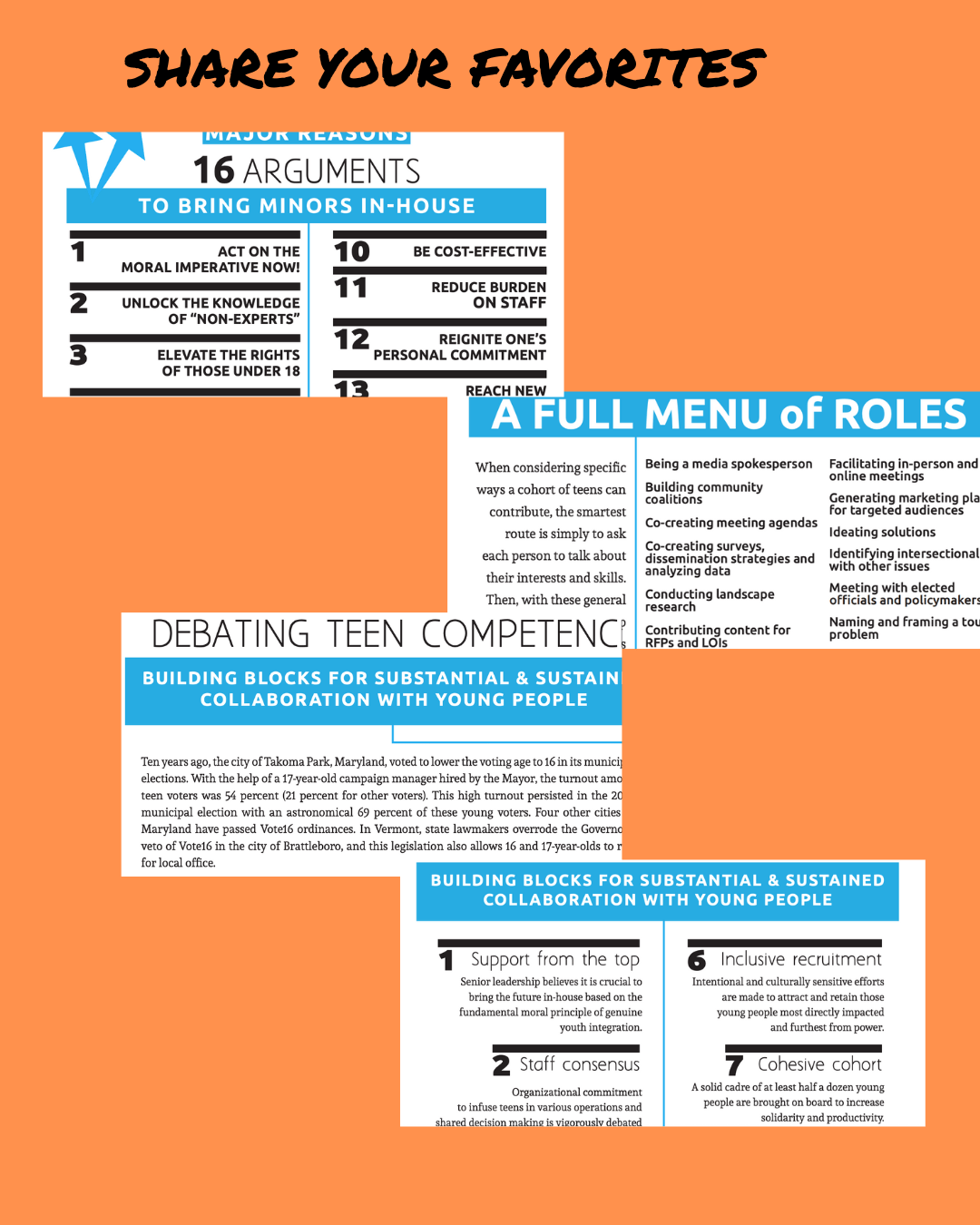
In the meantime, here are several of our one-pagers:

16 ARGUMENTS TO BRING MINORS IN-HOUSE

A FULL MENU OF ROLES

DEBATING TEEN COMPETENCE

16 CORE COMMITMENTS

Don’t keep your go-to resources to yourself—send them our way and help ignite a movement that values young people not just as future leaders, but as present-day partners. Many thanks! Wendy

Do You Have These 10 Critical Character Traits?

Building a collegial partnership with teens is altogether different from the traditional power dynamics so common with a parent, educator, or authority figure.

When introducing the concept of infusing teens into various organizational operations, the flood of reactions from most adults is predictably negative. 

My nephew is obsessed with online gaming. 

My friend’s 16-year-old daughter is so lazy and clueless. 

These kids don’t want to have anything to do with us. 

This crime wave . . . I’m scared of them. 

Adults must take off their hat as a parent, aunt, educator or other authority figure to see each young person as an individual. To unlock the minds of the rising generation to imagine a better society, analyze problems, and develop strategies to pursue real change together, the responsibility rests with adults to demonstrate authentic respect and build genuine rapport. A collegial partnership is altogether different from the power dynamics so common with a mom or dad, teacher or principal, etc. 

  Encourage us. Build on our ideas. That gives us the confidence we need.  – Melissa K.

Essential Soft Skills for Sustained Collaboration

  1. Optimist – Hold onto hope as the antidote to cynicism
  2. Listener – Develop a “Third Ear” to be open to new thinking
  3. Learner – Keep your imagination faucet open
  4. Advocate – Share your own pragmatic idealism 
  5. Communicator – Text or talk 1:1 outside of meetings 
  6. Comedian – Joke and laugh
  7. Infomaniac – Explain relevant organizational efforts and future plans
  8. Choreographer – Connect teens with other staff and organizations
  9. Honest Broker – Establish feedback loops to respond to ideas
  10. Catalyst – Implement proposals as quickly as possible to show change happens

The passing of my very dear friend and wonderful colleague inspired this list of character traits. Pat Moore Harbour, PhD possessed them all. She served as the catalyst for my involvement with one of the Kettering Foundation’s Research Learning Exchanges that builds off her book, Community Educators: A Resource for Educating and Developing Our Youth

Contagious Curiosity

Given my dogmatic and persistent nature, I challenge the prevailing mindset of adults doing “to” and “for” youth. Pat and I had dozens of conversations where she showed such respect and curiosity about my approach that young people be recognized as wise community educators, influencing their peers as well as adults and the community at large. Instead of viewing youth as “under construction,” we often talked about our kinship with older colleagues who are committed to anti-ageist multi-racial collaboration. 

When discussing the concept of youth infusion – especially those under age 18 – in adult-run nonprofits and government agencies, Pat always was intrigued and honest. Her sense of possibility led her to emphasize the role of young people as “co-producers.” She embraced collaboration “with” youth – the key preposition and title of the recent book by David Mathews, founder of the Kettering Foundation (read more about WITH  here).

I was eager to discuss with Pat these two studies that conclude most adults lack her curiosity and interest in intergenerational interdependence. She would have shared her contagious optimistic outlook. 

Every conversation with Pat was a joy. Children laugh 300 times a day and the average for adults drops to only 15. She had me laughing and rethinking all the time.

Many of my closest friends and colleagues are not open to this concept of engaging with teens as genuine thought partners but I will not give up because of Pat’s spirit that will endure. How fortunate I am to carry Pat in my head and heart!

Photo credit: Dr. Pat Moore Harbour

Avoiding Rubber Stamp Syndrome

Is this how young people feel when collaborating with adults? When asked for their ideas and input, do they feel is it too late? Do they sense there is little room to add new material or start from scratch?

I experienced a smidgen of what a young person might feel when collaborating with elders. Following my abbreviated summary, I’ll offer a few reflections on how to avoid the Rubber Stamp Syndrome where one feels as though they need to go along to get along. Spoiler alert: Don’t jump to the end.

Here’s what happened.

On short notice, I agreed to help facilitate an online workshop about how young people can participate in the public policy arena. I had no previous interaction with my co-presenter but knew they was not a novice. After only a minute or two sharing about our relevant experience, backgrounds, they shared their set of Google slides. My initial reaction was appreciation that they had done the heavy lifting. 

  • I had been preoccupied with a deadline and their initiative saved me time in developing an outline together. 
  • Another benefit: they knew the audience better than me. 
  • Their confidence and competence encouraged me to assume the role as backup singer rather than sharing the mic. 

Then my attitude shifted. 

Everything from the sequence of slides to the font size seemed set. They assured me we could change anything but that would bring into question their expertise. Teamwork and flexibility are in my DNA but I began to withdraw. It would be awkward for me to raise alternative or additional topics and this process could mean another 30-minute discussion. Rather than offer other suggestions, I expressed my appreciation that they serve as the lead presenter. Even though I wanted this subordinate role, the absence of a co-creative process actually bothered me. 

Is this how young people feel when collaborating with adult(s)? When asked for their ideas and input, do they feel is it too late? Do they sense there is little room to add new material or start from scratch? 

Guaranteeing Genuine Collaboration 

The presentation went smoothly. I chimed in a handful of times and tried not to interrupt their flow. Now for the part I left out: My workshop partner was 16 years old. This experience proved to be a superb reminder about the illusion of intergenerational collaboration.

Is it possible to avoid the Rubber Stamp Syndrome? Our interactive workshop dives deep into this chronic problem but here are just a few opening rounds to set the stage for equal footing in the co-creation process.

  1. Rapport – Start talking about something fun, weird, topical or newsworthy (less contrived than an icebreaker). Hopefully something you hear will spark your curiosity that keeps the two-way conversation relaxed.

2. Profiles – Share a few interesting and relevant highlights about your professional background but make sure not to drown out or intimidate. Without sounding like an interrogator, follow up with questions about their experiences and what sparked initial interest in this cause and/or organization.

3. Background – Give a brief rundown on the organization’s priority, goal, current situation, issue at hand, etc. and ask the preferred media for sharing more info (IG, Twitter, video, webinar, infographic, annual report, etc.).

4. Brainstorm – Introduce a future project or perhaps a dilemma and then volunteer that you don’t know have the answer or know how best to proceed. Ask for any immediate thoughts and then figure out together next steps and when to continue the discussion. 

Contact us about our Youth Infusion workshop that includes role plays and teaches strategies to achieve genuine collegiality that can result in a win-win for everyone and your organization.

“Radical Inclusion” in Action

This organization’s principled practice of Radical Inclusion is explicit: “expansively modifying boundaries in a way which creates a difference in the possibilities for engagement, as well as creating spaces that are more accessible, welcoming and inclusive of BIPOC youth and adults.”

Every youth-serving organization can learn critical lessons from UP for Learning where Youth Infusion is embedded in its culture and organizational structure.

Usually in the education sector, school administrators and teachers seek input from a handpicked cadre of students. The ideas and grievances expressed are noted but routinely discarded.

This statewide organization may have cracked the code. Executive Director Lindsey Halman is not exaggerating when she emphasizes UP for Learning’s commitment to “Radical Inclusion.” The traditional hierarchy has been replaced – teens and teachers are conspiring together to transform their archaic education system. In the words of a principal and team member: 


I had many opportunities to listen to youth; they reflected such a high level of introspection and passion. My takeaway was simple – no longer can change occur in education without youth-adult partnership.    


UP for Learning’s involvement at 95 percent of high schools across Vermont is moving the needle where students are recognized as experts and yes, equals. They sure know the difference! 

At my school, no one is asked what we think and when adults ask questions, they seem rhetorical.Maisie Franke, 10th grade

As the student rep, I never felt belittled by the school board but the structure isn’t there whereas on the UP Board of Directors, I never feel adult dominance. Galen Reese, 11th grade 

The UP Board of Directors is welcoming and super open, even if it is something negative. Alex Smart, 12th grade

It was only six months into my senior year that I ever spoke with any school decision maker. Now I meet regularly with the School District Leadership Board, the Vermont Equity Practitioners Network, and Rooted Organizing Communities. I SEE WE ARE PEERS.  Evelyn Monje, 12th grade 

Inclusive Representation

The organization’s principled practice of “Radical Inclusion” is explicit: “expansively modifying boundaries in a way which creates a difference in the possibilities for engagement, as well as creating spaces that are more accessible, welcoming and inclusive of BIPOC youth and adults.”

UP’s commitment to diversity in a state with a population that is 94 percent white provides additional lessons.

  • Recruitment. Reduce barriers (i.e., waive grade and attendance eligibility requirements, offer additional transportation, make extra efforts to collect signed permission forms for youth in foster care or unstable living situations)
  • Multi-lingual. Provide translators, recruit and compensate young bilingual co-facilitators, produce fliers in numerous languages, etc. 

Another secret that reveals Youth Infusion is how teens and teachers actually take turns at the steering wheel. The foundation is solid enough that its “full partnership” model is flexible. High school senior Alex Smart explains that sometimes it makes more sense for adults to approach school administrators and other times, full-time UP staff step back during student-centered forums. 

Measurable Outcomes

In addition to the intangible benefits resulting from intergenerational collaboration, here are a few examples of UP for Learning’s impact.

  • 2 new questions added to the Vermont Youth Risk Behavior Survey
  • 40 youth-adult teams engaged in yearlong Participatory Action Research projects
  • 7 monthly virtual racial justice dialogues between students in Vermont and Mississippi 
  • 1 hr/month the Winooski School Board meeting is devoted entirely to K-12 equity and antiracism work with youth facilitating these sessions

Youth Infusion continues to grow deeper roots in this organization. Student leaders have always been compensated for their work doing community outreach, analyzing survey data, etc. Now high school senior Evelyn Monje is the first part-time employee at UP for Learning. In my interview, it’s fair to say she does not sugarcoat anything so her statement carries extra credibility: “Youth-adult partnerships is the answer. There is so much growth and creativity and adults value this experience.”  

A teacher shares how transformative this experience has been.

Participating on this team was the BEST part of my school year. I began the year, quite literally, in August, during our first few days of inservice thinking – I don’t want to be a teacher any more, this system is too broken. I think I need to quit my job. I thought this a lot as the year continued. I am ending the year knowing that I want to keep working with youth, largely because of this team and seeing a new way to do it, and I want to explore my teaching role and explore special education or alternative education as a new career pathway.

Part of the reason I stuck with it and didn’t quit teaching was my commitment to this group and youth-adult partnership, which I found very healing and important. Thank you to everyone for making this possible.


Watch for a future blog about the groundbreaking intergenerational work in one Vermont school district to actualize 8 Antiracism Demands that, by the way, are translated in Swahili, Nepali and Somali.

Contact us to learn more about this and other organizations that live and breathe Youth Infusion and be the change you want to be!

Photo credit UP for Learning