What Teens Teach Us + Transform Adult Thinking 

If you’re reading this, thank you for rejecting screenagers, meanagers and countless other negative stereotypes that cause most adults to summarily exclude this age group in their organizatios. Whether young people are advocating for public schools, taking on billion dollar corporations, or reshaping the way adults see the world, their points of view carry a unique influence. Here are a few illuminating podcasts that remind us of how everyone gains a wider lens when adults chart a new path of youth inclusion and commitment to intergenerational growth. 

Get Schooled

On Election Day 2024, the Kentucky Student Voice Team played a crucial role in defeating a ballot amendment that sought to divert funding from public schools to private institutions. Imagine if only lobbyists and legislators had been active in this high stakes campaign . Two students interviewed highlighted how rural schools would be severely impacted, a perspective that carries significant weight—perhaps even more than that of the teachers’ union president or the legislator featured in this KSVT mini-series.

Baltimore Teens Persist!

This unforgettable episode of Code Switch delves into the fight against the $30 billion rail company CSX. Teens describe their reliance on their younger peers to bring “new ideas” and fresh tactics to this ongoing campaign, such as leaving bags of coal on policymakers’ doorsteps. These young citizen scientists combine hard evidence about coal dust with the lived experiences of elders, many battling cancer to make their case to state policy makers. . The co-host marvels at the “mutual respect” that emerges and admits she was initially concerned about exposing these youths to “grown-up cynicism.

Why Adults Lose the ‘Beginner’s Mind’

I love “children are the R&D wing of our species” in this Ezra Klein podcast. I have experienced many aha moments when hearing a new idea that emerges from a group of teens that oxygenates my mind. Professor Alison Gopnik describes “this kind of rebirth of plasticity and flexibility in adolescence…[to] consider new kinds of social possibilities, and to take the information that they got from the people around them and say, ‘OK, given that that’s true, what’s something new that we could do? What’s something different from what we’ve done before?'”

How to Better Understand Teens

This episode on 1A flips the script by starting with insights from 15- and 16-year-olds, followed by Ellen Galinsky, author of “The Breakthrough Years.” She credits 40 teens across the U.S. as

“co-creators” who took my research in a completely different direction than if I had just looked at the literature or just talked to adults.

Galinsky quotes a 12-year-old’s advice to adults: “Listen with – when I was a child’s mind – as well as now  – I’m an adult’s mind. In other words, understand our perspective, not just your perspective.” So much can be gained by this commitment to intergenerational interdependence.

Now It’s Your Turn. Please Share Your Favorites!

Photo Credit: Partnership for Southern Equity CEO, adult and youth staff

10 Reasons to Work with Young Researchers to Generate Solid Data

This survey and analytical process provide a stellar example why young people are needed to help evaluate existing programs as well as shape policy deliberations and decisions.

Post-millennials, who never have operated in a world without the internet, are pros at using an array of social media platforms. Less recognized is that many are adept with various online options that promote collaboration. It is second nature for many Gen Zers to use Google Docs, Slack, Zoom, etc.

One skill-set boosted by these digital tools is Youth Participatory Action Research (YPAR). It is no longer rare to see sophisticated data collection, analysis, and recommendations generated by this youth-led process. One driver of this trend is young people – especially minors –who know this advocacy strategy improves the odds that they will be taken seriously by the powers-that-be. 

Organizations, coalitions, and think tanks could benefit enormously by incorporating a YPAR strategy. Here are just a few reasons and the first one is the most valuable.

10 Reasons for YPAR

  1. To produce data that reveal potentially more honest responses from the most diverse generation ever; 
  2. To augment the expertise of professional researchers;
  3. To rethink typical survey questions and refine the language; 
  4. To deepen the qualitative and quantitative research skills of everyone involved;
  5. To use innovative dissemination strategies to reach target constituencies;
  6. To gather pertinent data to evaluate the effectiveness of programs, reassess priorities, and develop new initiatives; 
  7. To use data to strengthen the overall work and impact of your organization;
  8. To garner attention from the news media and policymakers;
  9. To save money since most employees and many consultants cost more than part-time young researchers; and
  10. To infuse young people – often the primary stakeholders – into the heart of your organization for the benefit of everyone

Formidable Skills Produce Pertinent Data

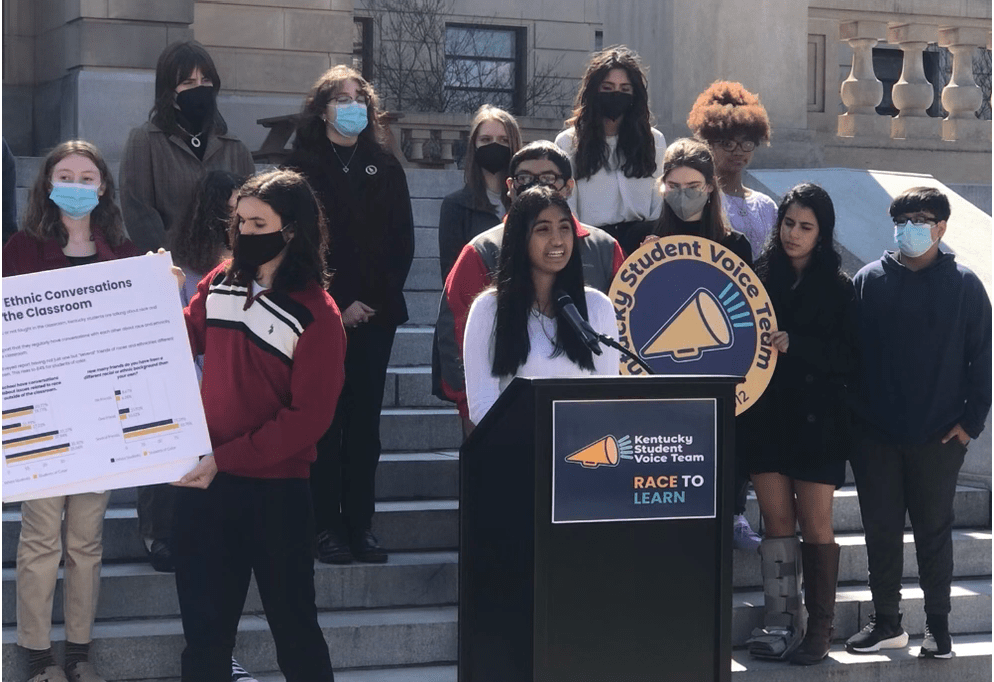
A first class example is Race to Learn by the Kentucky Student Voice Team (KSVT) based on 10,725 responses from 114 of Kentucky’s 120 counties. It was released during debate on state legislation to curb what is taught about race and ethnicity in the classrooms. 

Two excerpts reveal the integrity of their methodology, including an intentional strategy to include the most underrepresented students.

We designed our methods in consultation with our “Research Advisory Dream Team,” a group of adult allies with expertise in youth participatory action research (YPAR). We generated and refined our survey tool over the course of both asynchronous and synchronous sessions soon after the start of the 2021- 22 school year, and we did so in consultation with young people outside of our membership and with school and community-based educators throughout the state. 

The qualitative team analyzed the 23,094 responses to the six open-ended questions…the quantitative team analyzed 21 scaled questions. Our analysis included the identification of patterns in the data as we disaggregated it in order to compare the experiences of students of color and those of white students and make connections to what students were expressing in their open responses. From there, we were able to come to group consensus and prioritize some key data points and themes.

Race to Learn: Findings, Recommendations and Reflections from the Kentucky Student Voice Team’s Race, Ethnicity and School Climate Student Survey (March 2022)

Interspersed with the presentation of data are quotes by students that reflect a wide range of views but reinforce one finding that “46% of students report that their school needs to do more to confront racism.” Each of the recommendations drawn from the analysis deserves to be read in full (see page 13). 

There’s no doubt that the careful creation and wording of questions plus the dissemination through both formal and informal networks were what resulted in over 10K responses during only a two-week time frame. 

Model and Motive

The Kentucky Student Voice Team outlines its overarching goal on the first page of the report:

By operating as a transparent, inclusive, and collaborative team, and by documenting our process, we hope to provide a model for how young people and other stakeholders can act as citizen researchers to ensure more just and democratic schools and communities.

This research is a labor intensive undertaking, but young people like these Kentucky citizen researchers prove that the effort is worth it.

As you read about this impressive work, please share with us how your organization might infuse young people as interpreters of the grievances facing their generation and pragmatic solutions.

Additional Resources

For more information about the impact of intergenerational interdependence, contact us.