Skip to content
Youth Infusion Logo with arrows and vitality

Youth Infusion

interGEN Knowledge Bank

  • Home
  • Coaching
  • Blog
  • Hub
  • About the Book
  • Buy Book
  • Contact Us

Category: Education

NEW! Best Practices for Every City and Nonprofit

NEW! Best Practices for Every City and Nonprofit


With almost surgical precision that flattens the hierarchical separation between policy professionals and non-experts, there is a resource that details tested techniques for any organization dedicated to authentic collaboration with those directly impacted by its priorities and policies.


Cultivating Possibilities was released in early 2025 to document the “first-of-its-kind exchange” at the 2024 White House Youth Policy Summit. The U.S. Department of Education took the lead role with five other federal agencies. Given that the Trump Administration has targeted the Department of Education for elimination, one might assume this blueprint is now irrelevant. Despite ongoing turmoil also at the Department of Health and Human Services, the Department of Labor, and other agencies, this Summit was far more than a one-off photo-op. Ongoing follow-up may be at a standstill, but indelible changes have happened. The protocols and mindsets about the value of authentic engagement and how to partner with young people reflect an emerging trend at the state and local levels.

Think Nationally, Act Locally

If serious shared decision-making can happen in the vast federal bureaucracy, certainly state, county, and city organizations can adopt these fundamental principles and practices. Every city government and its infrastructure of agencies and commissions can use this framework. The same applies to community-based organizations from small neighborhood groups to large nonprofits.

For over 15 years, Hikma Sherka has been on the receiving end of token gestures where pizza and gift cards are how adults say thanks to young people who share their time and talents. In her recent position as Youth Engagement Coordinator in the Office of Secretary Dr. Miguel Cardona, Hikma told me how surprised she was by genuine “co-building” among the 7-member planning team and 270 Summit participants.

Here are some of the very intentional youth engagement methods that stand out. This uplifting, colorful 45-page report covers the pre-planning stage through concrete commitments as well as implementation.

Principles & Procedures

1. TAREGETED REPRESENTATION. Invite people, primarily between the ages of 16-24, who have lived experiences of government systems that have not worked for them. Seeking young people who will share their firsthand grievances is usually not a top priority.

2. RELIANCE ON COMMUNITY-BASED ORGANIZATIONS. Instead of an open call for individual applicants, Youthprise, Grip Tape and many other nonprofits across the country were key to recruitment. These youth-serving organizations know their constituencies.

3. PRE-PLANNING PREP. Youth organizations held online gatherings for youth participants to explain jargon, agency jurisdictions, youth development benchmarks and other Summit goals. These orientation sessions are particularly important for those who may not have “traditional leadership experience.”

4. CO-ARCHITECTS FROM THE GET-GO. Usually, adults dominate the design phase and ask a couple of young people to give feedback on a preliminary plan. Instead, an external team had nearly equal representation from the start, with four young people and three adults.

5. FREQUENT MEETINGS. The planning team met weekly—every Friday afternoon for five months—ensuring an accelerated decision-making process that also helps to get on the same page..

6. REGULAR ACCESS TO LEADERSHIP TEAM. Senior White House staff and representatives from the six agencies met monthly with the planning team. Often, there is limited substantive interaction between high level professionals and those involved with a youth project.

7. COMPENSATION. The planning team was paid for their time, and the 90 youth participants at the Summit received a “generous per diem” which covered travel expenses (including for adult allies if requested), and a clothing allowance. What to wear at official events like this can be stressful.

8. INCUBATOR SPACE. A separate area for young people allowed them to engage with their peers, grapple with issues, raise questions, and float ideas. This accommodation provides a safe zone, free from unintended judgment or intimidation by adults. A staffed wellness room was also available.

9. IMPOSTER PREVENTION. The importance and value of youth perspectives need to be emphasized repeatedly, but one subtle strategy deserves consideration. At this high-level Summit, nametags of participants and speakers did not include PhD, MSW or other honorifics. Avoiding business suits also was encouraged.

10. ATTENTION TO ATMOSPHERICS. An intergenerational team created a playlist. Poet laureates spoke throughout the Summit. A graphic facilitator captured concepts, language and priorities. An online meeting platform allowed all participants to communicate and network.

11. SETTING GROUND RULES. One Summit guideline stated that no federal policymakers could speak on stage without being in dialogue with young people. Co-facilitation can be uneven due to personality differences and public speaking experience, particularly between a 16-year-old learning about federal housing programs and a U.S. HUD expert. Plenty of time is necessary to build confidence and rapport.

12. CHANGING HABITS AND ATTITUDES. The planning team held a training for representatives of all participating agencies on the concept of adultism and power dynamics. Another unlearn and relearn training focused on communication and messaging including shifting the deficit-oriented narrative to youth experiences and capabilities

Working with young people in a different way strengthens the agencies, and moving forward, they’re going to continue to use their experience to shape their work. – Shital Shah, Senior Advisor of Strategic Partnerships at the Department of Education

Policy Outcomes

At the end of the Summit and six months later, here are a few of the actions taken but there are dozens more specific policies.

  • All six agencies committed to stop using “vulnerable” and “at-risk” youth in policies and program materials. A list was created to retire other terms such as “delinquent” and “neglected” youth.

  • U.S. Department of Labor pledged to hire young people in local, state, and federal government not only to share ideas but to raise awareness about the Workforce Recruitment Program.

  • U.S. Department of Health and Human Services and the Labor Department launched a pilot program to 1) reconsider zero-tolerance policies that hinder employment and 2) create policies that provide substance abuse resources for young people.

Youth are experts in their own lived experiences. When we are given agency, wellbeing, belonging, purpose, meaning, and leadership within our federal government to express our voices, we are empoowered to bring these values to our peers as well. – Sriha Srinivasan

This Summit was underwritten by the Fund for Adolescent Science Translation (FAST) that includes the Annie E. Casey Foundation, The Bezos Family Foundation, The Chan Zuckerberg Initiative, The Ford Foundation, The Hemera Foundation, The Conrad N. Hilton Foundation, Hopelab, Pivotal Ventures, The Raikes Foundation, Spring Point Partners, The Seattle Foundation and The Stuart Foundation. FAST is dedicating $400K to support young leaders and organizations as a follow-up to this White House Summit.

The entire process of including young people at the federal level to this degree is unprecedented.

Please share your reactions and other examples of substantive and sustained youth engagement at the local, state, or federal level.

Resources

Cultivating Opportunities – Report about this “first-of-its-kind exchange” White House conference

Seek Common Ground – Nonprofit managing the Fund for Adolescent Science Translation (FAST) grants

Why Aren’t We Doing This! Collaborating with Minors in Major Ways – Shameless plug for the book I co-authored with 19-year-old Denise Webb

Credit: One of several graphic images generated at the Summit

Unknown's avatarAuthor Wendy S. LeskoPosted on 03/07/202503/20/2025Categories – Wendy Lesko, Civic Engagement, Community-Based Organizations, Education, Funders, Government, Health, Intergenerational, Nonprofits, Youth-Adult PartnershipsTags Annie E. Casey Foundaation, Bezos Foundation, Cultivating Possibilities, FAST, Federal Government, Ford Foundaiton, Fund for Adolescent Science Translation, Hikma Sherka, mental health, Miguel Cardona, national conference, Shital Shah, Sriha Srinivasan, substance abuse, White House Summit, workforce development, youth leadershipLeave a comment on NEW! Best Practices for Every City and Nonprofit

“Check out”what’s happening in Libraries

“Check out”what’s happening in Libraries

“We are hearing the important word “co-design” more as libraries are designing programs “with” teens, not “for” them. Instead of planning first and bringing the teens in later, teens are given a seat at the table from the beginning. Libraries are going into communities and building relationships with trusted messengers, and if the goal is to develop programming for teens, then teens need to be among those trusted messengers. This movement reflects a larger trend of a ‘with them’ practice.”

This paradigm shift is described by Shari Henry, previously Director of Democracy and Community Impact with the Urban Libraries Council and who now works with the largest library system in Virginia. In addition to maximizing the impact of youth services, co-piloting with teens plots future directions for libraries and diversifying the career pipeline.

Instead of libraries becoming obsolete institutions, some innovative practices of inclusion are gaining traction.

Another visionary in the library universe is Liz McChesney, National Summer Learning Association Senior Fellow. She reviewed Why Aren’t We Doing This! Collaborating with Minors in Major Ways which I co authored with Denise Webb, now 20. McChesney says

“This practical and easy to use guide gives actionable examples of how to include youth and co-design for authentic engagement. This is a must read for all those who want more inclusive and equitable programs and services in their libraries that are designed with youth instead of for them.”


Prof. Anthony Bernier at California’s San José State University School of Information continues to push and prod libraries to move beyond traditional youth development framework. I am proud to have contributed a chapter in his book, Transforming Young Adult Services. I’m even prouder to share his review of our book..

In an inspiringly accessible narrative voice, Why Aren’t We Doing This – teaches the topics and addresses the concerns skeptics simply accept to justify why incorporating young people is just too hard.


Webb and Lesko illustrate how it’s not.


Their well laid-out Table of Contents usher readers through six logical arguments and strategies for disrupting legacies that exclude youth through inducting and infusing youth into the operational and strategic fabric of our organizations. Along the way Why Aren’t We Doing This shares real-world insights from their interviews as well as offers practical resources, such as the “Ladder of Real Vs. Token Youth Participation,” to help guide organizations away from superficial manipulations of young people through to genuine influence and power enhancing collaborations.


That said, as someone who teaches youth service professionals, I particularly appreciate the detailed content about appropriate on-boarding, coaching, and co-piloting techniques leading to authentic youth influence building.

Libraries = Community Hub!

Join Our National Hub!!

Join with other youth practitioners from many different sector in our online exchange about individual and institutional change to co-create with this demographic that is essential to innovation in every community. “Check out” Youth Infusion HUB @ LinkedIN.

Photo: El Gabilan Library – Salinas, CA

Unknown's avatarAuthor Wendy S. LeskoPosted on 07/01/202407/01/2024Categories – Wendy Lesko, Civic Engagement, Community-Based Organizations, Education, Intergenerational, Youth-Adult PartnershipsTags Americn Librry ssocition, DEI, diversity, libraryies, Liz McChesney, N, National Summer Lerning Association, nthony Bernier, Shri Henry, Urban Libries Council, Youth, Youth development, youth empowermentLeave a comment on “Check out”what’s happening in Libraries

Voting Rights Victory Lessons

Voting Rights Victory Lessons

When only 3 percent of voters cast ballots in the nonpartisan local school board elections, that’s a failing grade.  This negligible turnout in Newark, New Jersey means the top education decision makers have little reason to listen and respond to their constituents. And there is another systemic problem. How many adults –  including parents – have a deep understanding of what’s happening inside the schools? Certainly teachers do, but students have firsthand knowledge about curricula and testing, as well as nonacademic problems such as freezing classrooms and school lockdowns. 

Two students from different high schools, Yenjay Hu and Anjali Krishnamurti, discovered they had the same idea that those who spend over 36 hours a week in the classrooms  deserve to weigh in on decisions made by their school board.  They connected online through Generation Citizen’s Vote16USA and soon they co-founded Vote16NJ. This initiative is a major step beyond a  single nonvoting student representative on a school board that is often viewed as a token position.

Meanwhile, Micauri Vargas, Associate Counsel of the Democracy & Justice Program with the New Jersey Institute for Social Justice was contacted by Vote16NJ and that is how she learned about this student-led initiative. She then began her legal analysis that determined solid State Constitutional footing to expand voting rights to  16- and 17-year-olds for local school board elections. 

Building an interGEN Coalition

Vargas, who describes herself as a “junior attorney” got the green light to work on this campaign even though there was no specific funding allocation. Typical of many legislative  campaigns, the behind-the-scenes work can be slow but once the stars align, immediate action is needed before the political universe changes. While the NJ Institute, NAACP and other orgs worked their connections, Vargas kept in frequent contact with Vote16NJ and also connected with other local youth-serving organizations to broaden the faces of this movement. 

Lowering the voting age to 16 is one of the best issues to consider how you view teens and their competence. Everyone who does this 15-minute exercise debating the pros and cons and shares how their thinking evolved with me via text (301-785-1702) or wendy@youthinfusion.org will get a FREE copy of our 160-page book,“WHY AREN’T WE DOING THIS! COLLABORATING WITH MINORS IN MAJOR WAYS,” coauthored by 19 year-old Denise Webb.

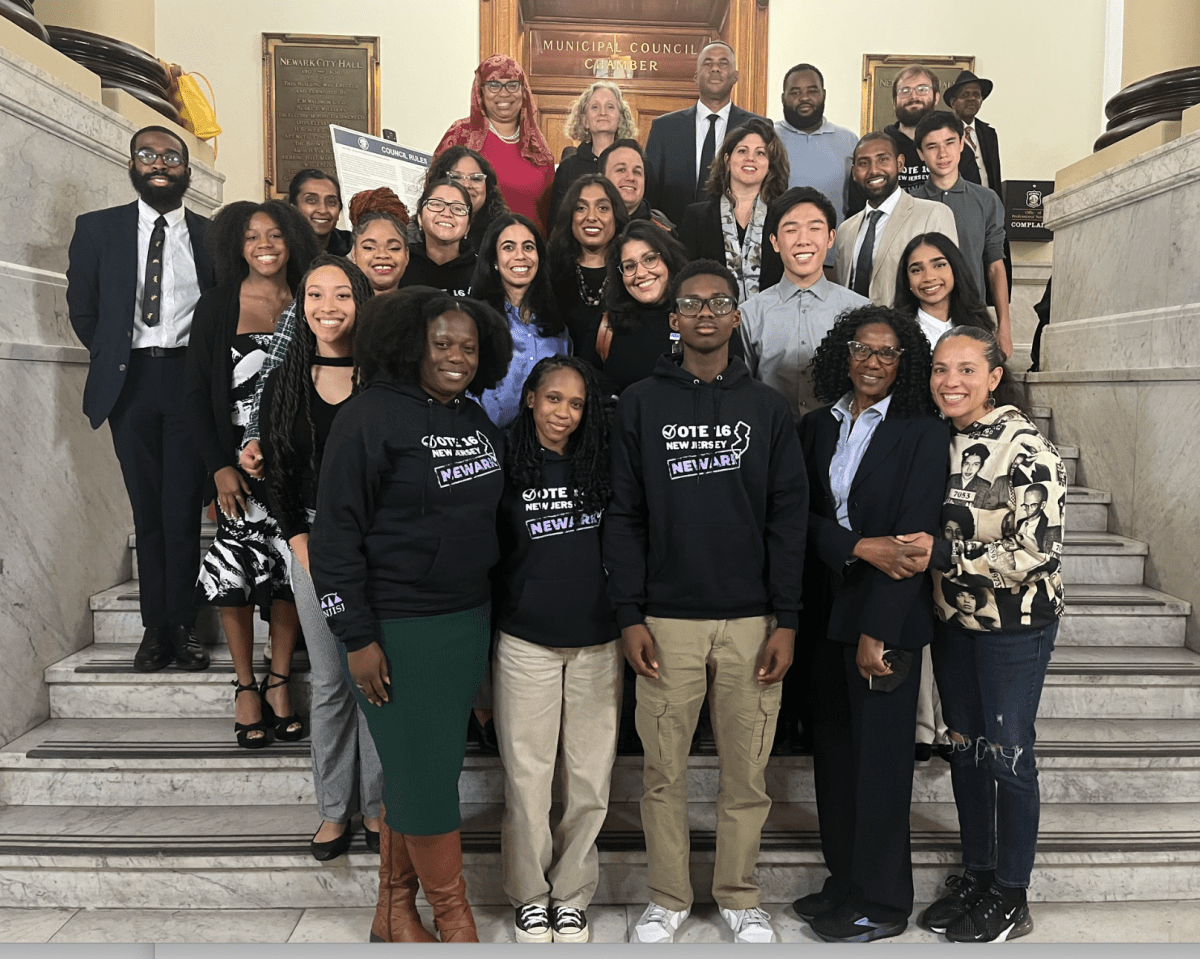
Three years later, 12th grader Hu describes the unanimous vote by the Newark City Council as “surreal” and knows the legal expertise and political connections of this intergenerational coalition were essential.  Often, organizations keep the non professionals on the sidelines but Krishnamurti , now 18, grins while describing Vargas as

“absolutely amazing…she genuinely wants the voices of young people and views us as equals and as her colleagues.” 

Micauri Vargas describes the student activists as

“my partners and that there is a mutual teaching element but there is a difference if they have not entered the working world.”

The easy rapport and frequent exchanges (Zooms and informal meetings) provided the on ramp for “tough conversations” ranging from strategic moves such as who is standing on the podium.  This campaign reveals the predictably complex dynamics between teen activists who have a handful of free hours each week and professionals who devote many hours a day and how youths and adults alike successfully navigate the steep learning curve. 

With voting rights under attack, the New Jersey Institute for Social Justice could have decided not to prioritize youth suffrage but recognized Vote16 builds lifelong habits of civic engagement and extends representation to those directly impacted. Anjali Krishnamurti says “It took a lot of courage for them and I remember Micauri thanking the NJISJ CEO for ‘believing in me and to take this leap of faith.’” 

The upcoming school board election is fast approaching.  Implementation of this city ordinance will require all hands-on-deck with legal experts working on registration and ballots along with young activists, teachers and community-based organizations co-creating plans so that 7,000 students become aware of their eligibility to vote. This historic win may cause older voters to be more aware of this election and increase turnout above the abysmal 3 percent. This interGEN coalition represents the powerful impact when  people of all ages work together to confront the challenges of today and tomorrow. 

A Few More Takeaways

  • Create coalitions that always include young people
  • Students in the 9th and 10th grades are an ideal age because they have years – not a few months – to organize and advocate
  • Be intentional about recruiting young people from all backgrounds to ensure broader representation
  • Junior level staff need the support of senior leadership
  • 1:1 meetings keep young people in the loop and avoid misunderstandings 
  • Everyone’s knowledge is respected, regardless of age or background.

Extra Info

  • Center for Democracy and Civic Engagement
  • Center for Information and Research on Civic Learning & Engagement
  • Debating Teen Competence Exercise and GET A FREE BOOK!
  • National Student Board Member Association
  • New Jersey Institute for Social Justice
  • Vote16NJ
  • Vote16 USA 
  • Youth Competence is a Game Changer

Join our LinkedIn Group to participate in this and other conversations!

Unknown's avatarAuthor Wendy S. LeskoPosted on 02/01/202402/02/2024Categories Civic Engagement, Education, Elections, Government, Intergenerational, UncategorizedTags #Vote16, classrooms, coalition, NAACP, Newark Board of Education, Newark City Council, NJ Institute for Social Justice, school lockdowns, Student Voice, teen civic leadership, Vote16NJ, votingh rights, votingrights, youth leadership, youth suffrageLeave a comment on Voting Rights Victory Lessons

Why Are Adults Like This…When They Were All Young Once!

Why Are Adults Like This…When They Were All Young Once!

Guest Author: Addie Lentzner

When I was 13, I had no idea that I had a voice. I accepted my schooling situation as out of my hands, I thought my life was basically being decided for me at that point. Little did I know that I would soon find out the opposite, and make it my mission to ensure other students know what I learned.

The first step in this youth infusion journey was starting an anti-racism group at my school. Seeing daily microaggressions, coming to understand systemic racism, and feeling as though schools didn’t teach an accurate and inclusive curriculum compelled me to do this. With apprehension, I wrote to my principal, and to my surprise she approved the club. I didn’t know students had that authority! But I still didn’t see myself as an equal to the adults in the room. Even starting a statewide group didn’t convince me that students are and should be the experts…I still felt as though I was under the authority of people based on age. 

Voiceless to “Having a Say”

Then COVID-19 hit, and I got frustrated and dismayed. Adults weren’t listening to our needs – we were asked to continue doing loads of homework while facing a literal pandemic, as well as a racial justice reckoning. Where was the equality, as we all sat on our Zoom screens with our cameras off, the teacher the only one with it on? How was this seen as okay?

Working As Equals with Adults

The transformation came when I was 16. Craving an outlet for my disillusionment with the education system, I came across Our Turn. Our Turn is a national nonprofit working to uplift student voices in the fight for education justice.

I started as a Communications Fellow, and soon transitioned to Executive Fellow, where I worked with the CEO. I found myself amazed: I could text the CEO, an adult, and pitch an idea that he would actually consider! I had weekly meetings with adults on the team who took me absolutely seriously. I was able to work on projects, such as reports, as an equal partner with an adult, and I spoke at panel events as the only youth…but was respected completely. 

This was, at the very least, a paradigm shift. I began working closely with adults in my day to day life, working one on one with professors and teachers, and overall seeing myself as an equal. After all, we’ve all been youth once, it’s ridiculous that adults feel as though younger people shouldn’t have a voice. In fact, I soon became the Executive Director of a completely youth run organization with a staff and board composed of mostly people under age 22. This was also a paradigm shift.

I found my voice, and I found the truth: youth should be equals. I understand that adults have years of wisdom and experience, I’m not trying to discount that. I’m only saying that young people should be given a seat at the table – heck, they should be at the front of the table in conversations that are about their own education.

But many youth don’t know the highly suppressed secret of their power. Instead, youth are forced to sit behind Google Meets screens or at desks, neglect what they’re passionate about, and feel the inequalities of the world coming down on them. How is this fair?

Youth inclusion and infusion can radically change inequities . . .

Bringing students of color, low income students, LGBTQ+ students, students with disabilities, and other too often unheard of students to the forefront can alter the systems of society. If youth who experience inequities are able to lead nonprofits, assist in government, and make important decisions…we will truly change things.

I would like to live in a world where all young people have an equal voice, an equal say. I urge adults to begin walking the talk and giving youth the attention and space they deserve to make a difference. And youth, I urge you to not be afraid to speak out. I was afraid at first, but once I did it, there was no going back. Youth voice is a powerful tool, but it’s only truly powerful if we all are included.

Learn More . . .

  • Study Our Turn  and their Student Agenda 
  • Check out redlining and other initiatives of Vermont Student Anti-Racism Network

Share other organizations engaged in interGEN work at  our LinkedIN Youth Infusion HUB

Unknown's avatarAuthor Wendy S. LeskoPosted on 11/13/2023Categories Education, Intergenerational, Nonprofits, Youth-Adult PartnershipsTags Addie Lentzner, DEI, Education, Our Turn, public schools, Student Voice, youth civic engagement, youth leadershipLeave a comment on Why Are Adults Like This…When They Were All Young Once!

Vital Responses to “Youth Voices”

How decision makers can go the extra mile by listening to those under age 18 and then take action.

Vital Responses to “Youth Voices”

Community listening sessions and summits held by policymakers can provide valuable clues about systemic problems and generate pragmatic remedies. If ideas receive a perfunctory thank you and no followup discussion occurs, the lack of response can cement cynicism.

“Youth voice” is today’s mantra for encouraging teens to speak up but this high school student expresses deep frustration felt by many aspiring change agents.

“I think the biggest challenge we face is not being heard. I have encountered adults who ask us what is wrong or what do you need, and they say ‘I hear you.’ But they don’t do anything. It’s a fake presence. It’s fake love. ‘I’m here for you,’ but not really”. – Keyon Williams, Anacostia High School

Source: Whose responsible for D.C. violence? Ask the youths closest to it. Courtland Milloy, Washington Post 1/17/23

Decision makers have a tough job being responsive to the multitude of grievances and solutions offered by people from all walks of life. The powers-that-be have to go the extra mile to keep the dialogue going with people under age 18 because most of these non-voters don’t see the value in sharing their insights because their ideas are not valued. 

Premeditated Inclusion!

Intentional commitments and accountability are essential to replace performative acts of youth engagement. This is new and not easy. We are watching events unfold in Rhode Island with the hope that this time serious and sustained collaboration with public school students happens. Specific advice is noted below that is relevant to any adult-run organization that is ready to engage in radical inclusion with those most impacted and furthest from power. 

  • The newly elected Mayor Brett Smiley pledged to address the ongoing crisis of the Providence Public School District that continues to be under state control. During his first week in office, he held a three-hour education listening session. This forum can be seen on the UPriseRI channel.
  • Smiley’s opening remarks thanked parents, teachers, advocates and many policymakers for participating in this event. Make sure to mention the primary stakeholders – those who spend 35 hours a week in the classroom. 

  • Following breakout sessions, each group reported highlights of their discussion. Often at  many public hearings where decision makers look at their cell phones, engage in side conversations or leave the room. Mayor Smiley appeared attentive during the presentations by Jayliana and Kim, two high school students pictured above.

Several Recommendations

MENTAL HEALTH – redirect the funds earmarked for police in schools to provide more support for counselors 

ADA – install ramps in schools and do not require a doctor’s note for a student to use an elevator 

AFTER SCHOOL LEARNING – provide stipends and advertise these opportunities 

DISTRICT-WIDE STUDENT COUNCIL – identify and address disparities and “center youth voices, reach out to youth and tell them that we’re here to listen”

  • The friendly MC for this first event held by the Mayor praised the students for sticking to the time limit and urged the other breakout groups to follow their example. Not a single word was uttered by anyone on stage about the substance of the issues they raised. Decision makers have to go out of their way to prove they are listening and hearing what young people are saying and then they must promise to wrestle with those ideas. Students, who decide to invest their time and expertise, have to be met with genuine respect and open minds.

  • Prior to this Education Workshop, the Mayor received a letter of demands by the Providence Student Union. One might think this youth-led advocacy organization would have given up on the powers-that-be and they even use the words  “multi-generational collaboration.”

We at the Providence Student Union believe in multi-generational collaboration. Improving our school system cannot come at the expense of those currently attending these spaces every day and cannot happen without working together with those who hold various roles in our community.  

Providence Student Union letter to Mayor Brett Smiley

Will the Mayor and his administration commit to a timetable? 

Will he announce concrete steps to put in place a structure in response to these two specific proposals for a district-wide student council and a working group with all stakeholders?

Will students be involved in designing how these groups will operate? 

Will there be dedicated staff to communicate and convene regularly with these groups?

Will there be workshops where the  adults and students create norms that ensure everyone shares the mic and is on an equal footing?  

Heed the advice of this recent Providence Public School District graduate who is one of my best teachers: 

Why do adults ask us to be open-minded when they don’t rethink what they believe? – Milly Asherov, Classical High School Class of 2022 and long-term leader with the Providence Student Union

Please Share How You Are Going the Extra Mile!

Additional Reading

  • More about intergenerational collaboration in Providence 
  • Providence Student Union 
  • Leading Thinkers Rely on Young Minds
  • “Radical Inclusion” in Action
  • 10 Reasons to Collaborate with Young Researchers to Generate Solid Data
Unknown's avatarAuthor Wendy S. LeskoPosted on 01/22/202301/24/2023Categories – Wendy Lesko, Civic Engagement, Education, Government, Intergenerational, SchoolsTags Courtland Milloy, listening sessions, Mayor Brett Smiley, Milly Asherov, Providence Public School District, Providence Student Union, Rhode Island, srtudent voices, UPriseRI, youth summits, youth voice2 Comments on Vital Responses to “Youth Voices”
LinkedIN Logo for our group

JOIN US

We're INfusing together NOW!

Our youth staff are not an afterthought, not our guinea pigs or focus group. They are in the work and I’m really excited!! - Robyn Bussey, Partnership for Southern Equity

Youth Infusion IS happening! Sign up and learn the latest.
(Your email address will never be shared.)

Latest Posts

  • Election Lessons for Every Organization
  • IGNITING IDEATION WITH YOUNG PEOPLE
  • The Hidden Cost of Ignorance: Understanding Youth Perspectives
  • Let’s Recharge Our Batteries Together
  • Attn Policymakers: Research Shows Parents Misread Their Own Child’s School Experience
  • Home
  • Coaching
  • Blog
  • Hub
  • About the Book
  • Buy Book
  • Contact Us
Youth Infusion Create a website or blog at WordPress.com
  • Subscribe Subscribed
    • Youth Infusion
    • Join 36 other subscribers
    • Already have a WordPress.com account? Log in now.
    • Youth Infusion
    • Subscribe Subscribed
    • Sign up
    • Log in
    • Report this content
    • View site in Reader
    • Manage subscriptions
    • Collapse this bar