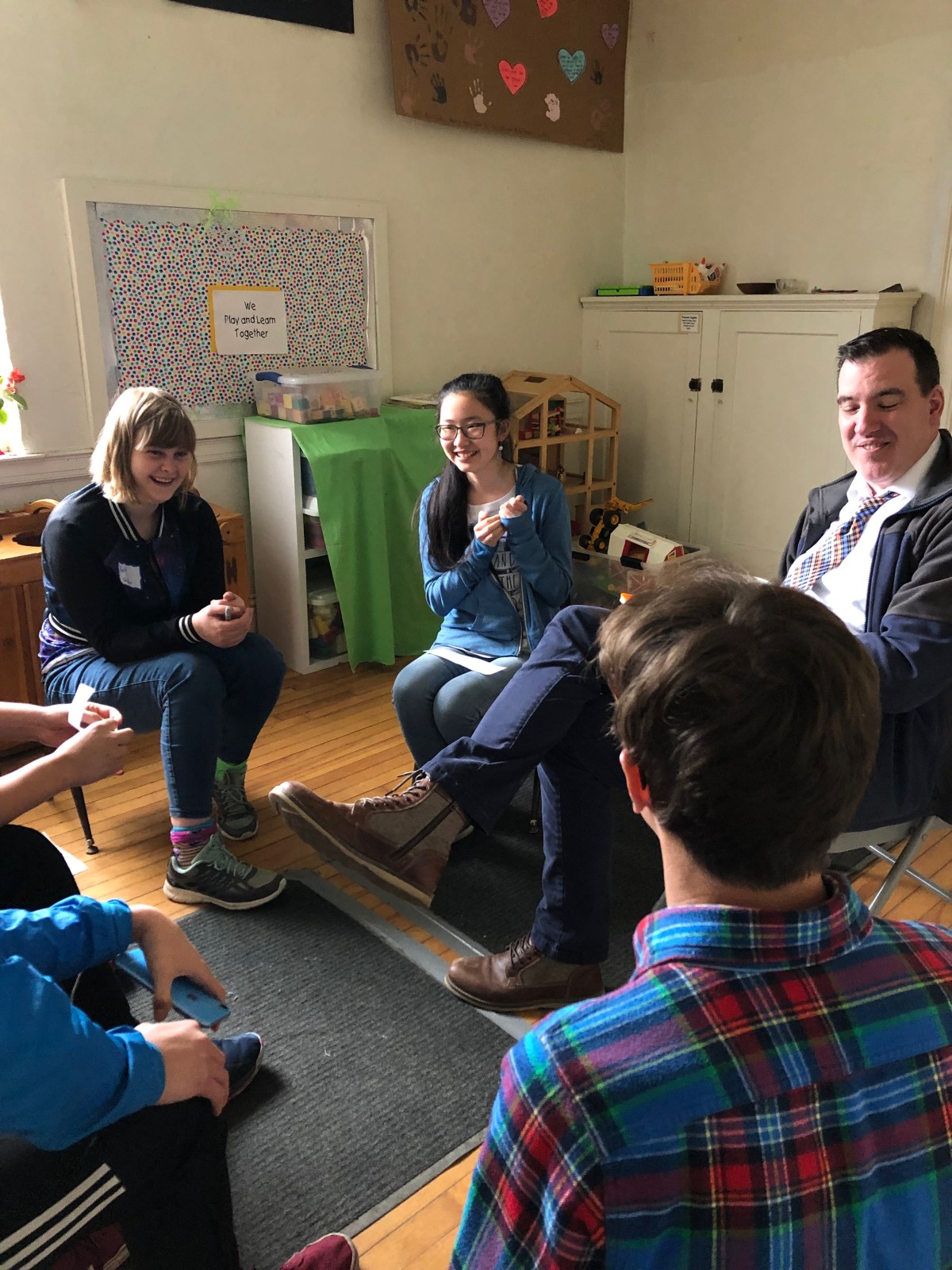
All the chaos, cruelty, and cynicism can make it tempting to retreat to familiar surroundings and friends—often people your own age who may share similarly dystopian views. But I’m continually refueled when interacting with much younger minds, especially when talking about how “the world sucks.” These conversations may not always delve into history or generate profound insights. Instead, they offer a chance to see the world through different eyes. That wider lens reignites my brain.
Most organizations—often due to legal concerns—don’t bring people under age 18 into the heart of their operations. But there’s a rising tide pushing back against the idea that professionals and experts should substitute for the lived expertise of young people themselves.
“I am not becoming. I’m not in the making. I’m a full human being with thoughts and creativity and wisdom to offer.” — Evelyn Monje, first high school employee hired by UP for Learning
Instead of being a burden, intergenerational collaboration uplifts everyone—from senior leaders to junior staff. Sophia Montemayor of Healthy Futures of Texas puts it best: “I genuinely love this work.” She describes her young collaborators as “battery chargers” and adds, “the evening meetings with these high school students make me forget how much I like to be in bed early.”
How can we help one another experience this same boost and joy? Light hearted and serious resources alike can offer strategies to navigate the complex dynamics of engaging young people in ways that enhance both credibility and effectiveness.
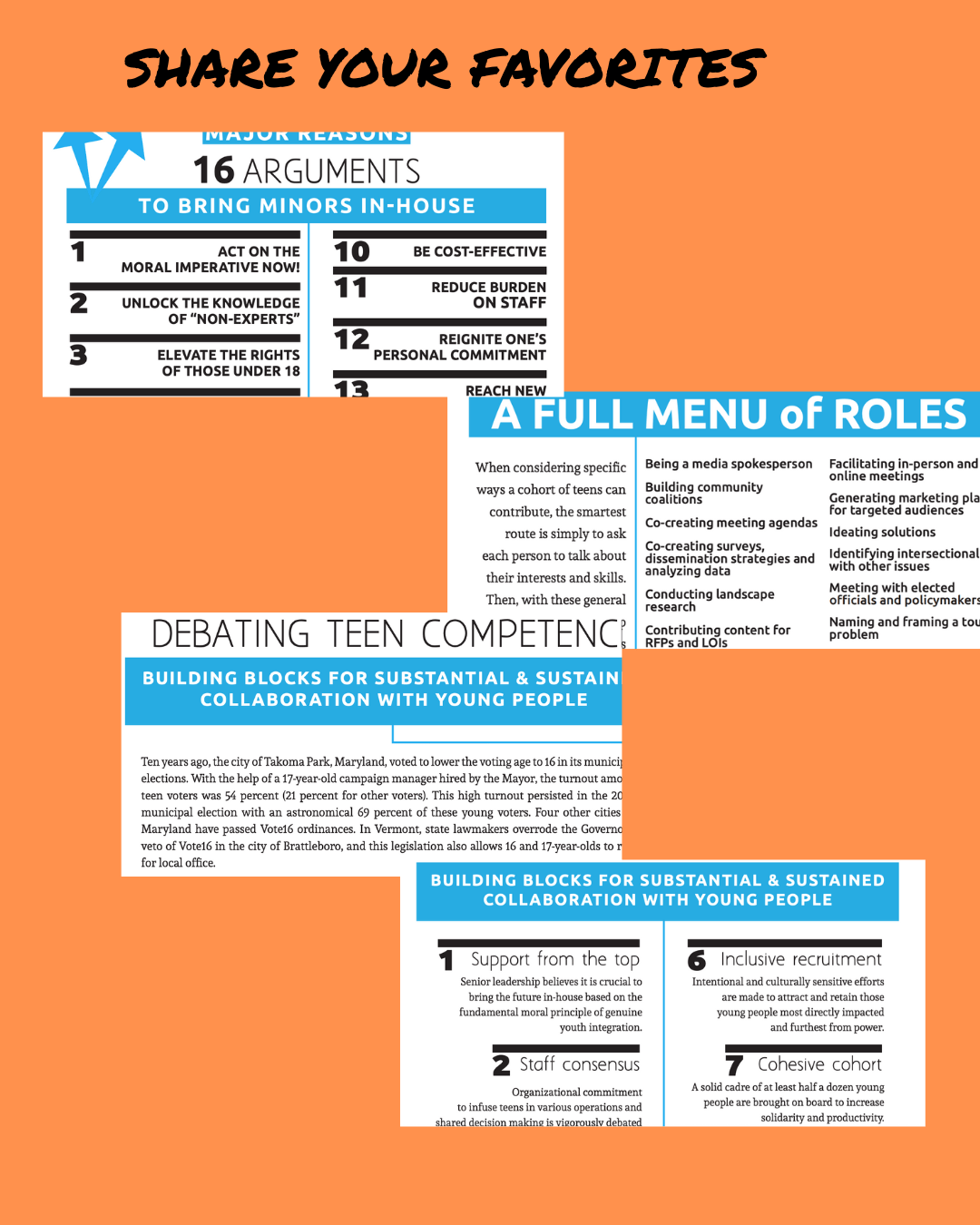
Will You Share Your Favorites?
We are collecting resources in all kinds of formats, including:
Google slide(s) with a compelling quote or graphic
IG post
YouTube video
Podcast or webinar
Article
Toolkit
Book or dissertation
Please use this link to contribute your recommendations. If your submission is included in our forthcoming 25 Cool Clever Youth Infusion Resources in 2025 (working title), you’ll receive a free copy!
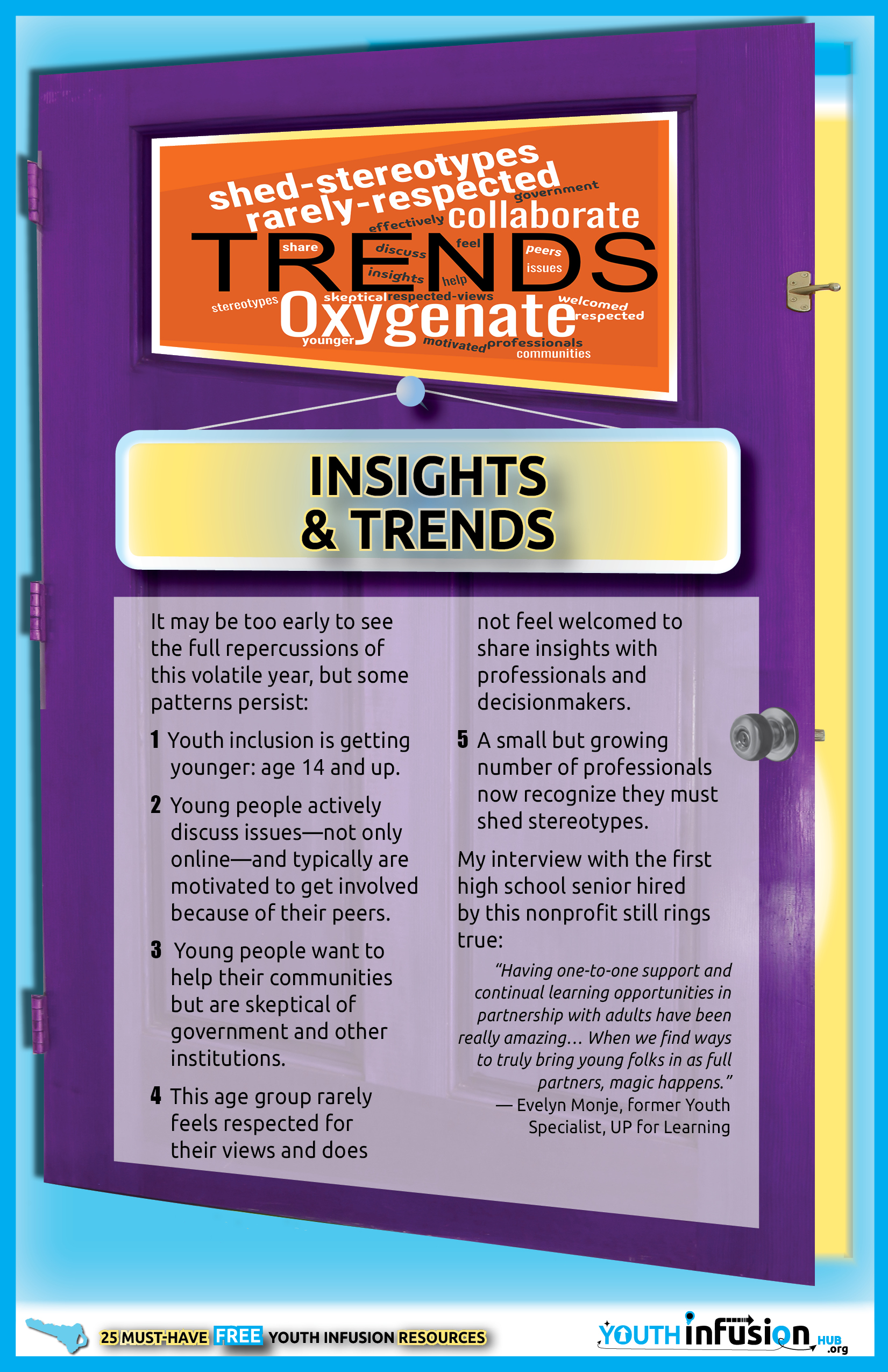
In the meantime, here are several of our one-pagers:
Don’t keep your go-to resources to yourself—send them our way and help ignite a movement that values young people not just as future leaders, but as present-day partners. Many thanks! Wendy
This organization’s principled practice of Radical Inclusion is explicit: “expansively modifying boundaries in a way which creates a difference in the possibilities for engagement, as well as creating spaces that are more accessible, welcoming and inclusive of BIPOC youth and adults.”
Every youth-serving organization can learn critical lessons from UP for Learningwhere Youth Infusion is embedded in its culture and organizational structure.
Usually in the education sector, school administrators and teachers seek input from a handpicked cadre of students. The ideas and grievances expressed are noted but routinely discarded.
This statewide organization may have cracked the code. Executive Director Lindsey Halman is not exaggerating when she emphasizes UP for Learning’s commitment to “Radical Inclusion.” The traditional hierarchy has been replaced – teens and teachers are conspiring together to transform their archaic education system. In the words of a principal and team member:
I had many opportunities to listen to youth; they reflected such a high level of introspection and passion. My takeaway was simple – no longer can change occur in education without youth-adult partnership.
UP for Learning’s involvement at 95 percent of high schools across Vermont is moving the needle where students are recognized as experts and yes, equals. They sure know the difference!
At my school, no one is asked what we think and when adults ask questions, they seem rhetorical. –Maisie Franke, 10th grade
As the student rep, I never felt belittled by the school board but the structure isn’t there whereas on the UP Board of Directors, I never feel adult dominance.–Galen Reese, 11th grade
The UP Board of Directors is welcoming and super open, even if it is something negative.–Alex Smart, 12th grade
The organization’s principled practice of “Radical Inclusion” is explicit: “expansively modifying boundaries in a way which creates a difference in the possibilities for engagement, as well as creating spaces that are more accessible, welcoming and inclusive of BIPOC youth and adults.”
UP’s commitment to diversity in a state with a population that is 94 percent white provides additional lessons.
Recruitment. Reduce barriers (i.e., waive grade and attendance eligibility requirements, offer additional transportation, make extra efforts to collect signed permission forms for youth in foster care or unstable living situations)
Multi-lingual. Provide translators, recruit and compensate young bilingual co-facilitators, produce fliers in numerous languages, etc.
Another secret that reveals Youth Infusion is how teens and teachers actually take turns at the steering wheel. The foundation is solid enough that its “full partnership” model is flexible. High school senior Alex Smart explains that sometimes it makes more sense for adults to approach school administrators and other times, full-time UP staff step back during student-centered forums.
Measurable Outcomes
In addition to the intangible benefits resulting from intergenerational collaboration, here are a few examples of UP for Learning’s impact.
2 new questions added to the Vermont Youth Risk Behavior Survey
40 youth-adult teams engaged in yearlong Participatory Action Research projects
7 monthly virtual racial justice dialogues between students in Vermont and Mississippi
1 hr/month the Winooski School Board meeting is devoted entirely to K-12 equity and antiracism work with youth facilitating these sessions
Youth Infusion continues to grow deeper roots in this organization. Student leaders have always been compensated for their work doing community outreach, analyzing survey data, etc. Now high school senior Evelyn Monje is the first part-time employee at UP for Learning. In my interview, it’s fair to say she does not sugarcoat anything so her statement carries extra credibility: “Youth-adult partnerships is the answer. There is so much growth and creativity and adults value this experience.”
A teacher shares how transformative this experience has been.
Participating on this team was the BEST part of my school year. I began the year, quite literally, in August, during our first few days of inservice thinking – I don’t want to be a teacher any more, this system is too broken. I think I need to quit my job. I thought this a lot as the year continued. I am ending the year knowing that I want to keep working with youth, largely because of this team and seeing a new way to do it, and I want to explore my teaching role and explore special education or alternative education as a new career pathway.
Part of the reason I stuck with it and didn’t quit teaching was my commitment to this group and youth-adult partnership, which I found very healing and important. Thank you to everyone for making this possible.
Watch for a future blog about the groundbreaking intergenerational work in one Vermont school district to actualize 8 Antiracism Demands that, by the way, are translated in Swahili, Nepali and Somali.
Contact us to learn more about this and other organizations that live and breathe Youth Infusionand be the change you want to be!